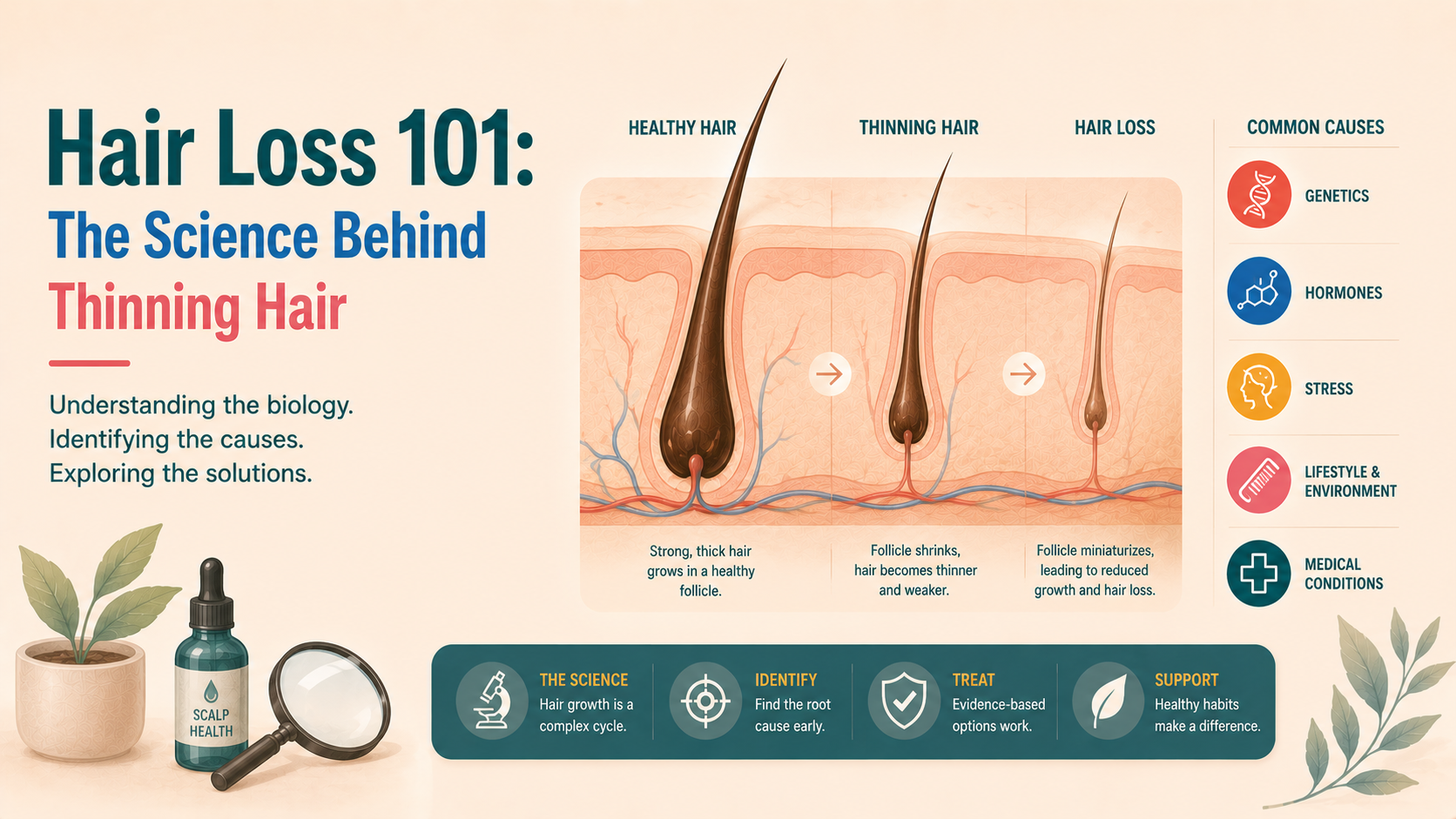
Scalp follicles cycle through growth and shedding phases. Anagen is the active growth phase, catagen is the short transition phase, and telogen is the resting phase before a hair sheds. In androgenetic alopecia, anagen becomes progressively shorter in susceptible follicles, so hairs grow shorter and finer. In telogen effluvium, too many follicles shift into telogen at once, causing noticeable shedding. Understanding the cycle helps explain why treatments take months: a follicle must move through biological phases before visible changes appear.
DermNet: Trichoscopy of generalised noncicatricial hair loss — https://dermnetnz.org/topics/trichoscopy-of-generalised-noncicatricial-hair-loss; Anastassakis K. Androgenetic Alopecia From A to Z, Vol. 1, Springer, 2022 — https://doi.org/10.1007/978-3-030-76111-0; Parikh AK et al. Advances in Topical Therapies for Alopecia, Life, 2024 — https://doi.org/10.3390/life14121577