Join the Newsletter
Androgens play a role in female pattern hair loss and in hair loss linked to conditions such as polycystic ovary syndrome (PCOS). Anti-androgen drugs – spironolactone, cyproterone acetate, certain oral contraceptives, flutamide, bicalutamide and 5α-reductase inhibitors – are used to blunt this influence. This article explains when and why they are used, what the evidence shows regarding efficacy and side effects, and how to determine whether they are appropriate for a particular woman.
![[headshot]](https://cdn.prod.website-files.com/68207da82e5b8c350c67932f/68c6a7436a552c0fe87a4da7_Screenshot%202024-11-27%20at%2011.38.11.png)
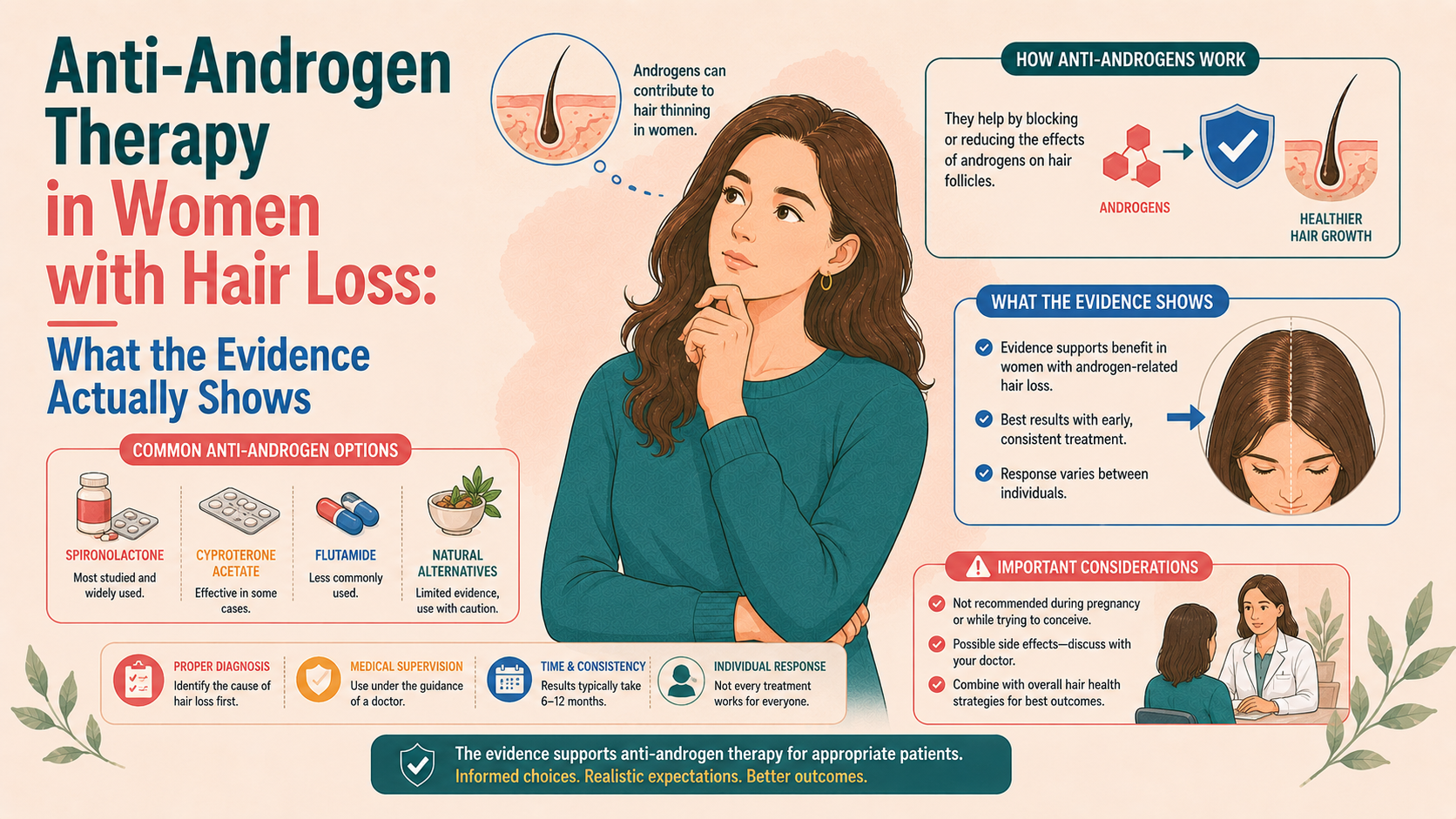
Female pattern hair loss (FPHL) – the female expression of androgenetic alopecia – is driven by a mixture of genetics, hair follicle sensitivity and, in many but not all women, androgen signalling.
Several observations support a hormonal component:
At the same time, FPHL can occur with entirely normal blood androgen levels, and even in women with androgen insensitivity. So not all FPHL is purely “androgen driven”; follicular sensitivity and oestrogen balance matter as much.
In practice, anti-androgen therapy is usually considered when female pattern hair loss (FPHL) is moderate to severe and/or when there is evidence of hyperandrogenism (clinical or biochemical), and/or when minoxidil alone has been inadequate.
It is almost always added to, not substituted for, minoxidil.
Spironolactone is a potassium-sparing diuretic and aldosterone antagonist with additional anti-androgen effects. Aldosterone is a natural hormone that primarily helps regulate blood pressure and sodium and potassium levels.
In FPL, spironolactone blocks androgen receptors in target tissues, including hair follicles, reduces androgen production in the ovaries and adrenal glands, and increases sex hormone-binding globulin in some women, lowering free testosterone levels.
The net effect is a reduction in androgen signalling at the follicle.
Spironolactone has been used in women with FPHL for decades. The bulk of the evidence comes from retrospective series and uncontrolled cohorts, smaller prospective observational studies, and, more recently, a systematic review of its use in FPHL and other forms of alopecia.
Across these studies:
It is important to be honest: these are not placebo-controlled phase III trials. They are, however, reasonably consistent in indicating that spironolactone helps a substantial subset of women with FPHL, particularly those with signs of androgen excess.
Common side-effects include:
Spironolactone can increase serum potassium, particularly at higher doses and in women with underlying kidney disease or those taking other potassium-sparing drugs. In otherwise healthy young women, dangerous hyperkalaemia is rare, but many clinicians still obtain baseline and early follow-up electrolytes, especially for doses above 100 mg/day.
Spironolactone is not suitable in pregnancy; animal data suggest a risk of feminisation of male fetuses. For that reason, it is usually combined with effective contraception if used in women of childbearing potential.
Cyproterone acetate is a synthetic progestin with strong androgen receptor antagonism. It suppresses gonadotropins (sexual hormones) and reduces ovarian androgen production.
It is used in two broad ways:
Evidence in FPHL includes:
CPA is licensed in some regions for hirsutism and severe acne with androgen excess; its use in FPHL is off-label but supported in guidelines as an option where hyperandrogenism is present.
At higher cumulative doses, CPA has been linked to weight gain, mood changes, reduced libido, an increased risk of liver dysfunction, and, crucially, an increased risk of certain types of meningioma (tumours of the nervous system sheath) with long-term high-dose exposure.
Modern practice generally uses lower doses for limited durations where possible, monitors liver function and neurological symptoms, and avoids high cumulative doses in women who have other risk factors for meningioma.
CPA is also teratogenic and must be paired with contraception if used in women who could become pregnant.
Some combined oral contraceptives (COCs), particularly those containing ethinyl estradiol plus drospirenone (a spironolactone analogue) or low-dose ethinyl estradiol plus cyproterone acetate (CPA), have antiandrogenic properties.
Trials in women with hirsutism demonstrate reductions in hirsutism scores, lower free androgen levels with corresponding increases in sex hormone binding globulin (SHBG), and improvements in acne.
For female pattern hair loss (FPHL), the evidence is less direct. However, these preparations are often used to regulate menstrual cycles, reduce hyperandrogenic features, and provide contraceptive cover when other antiandrogens are prescribed.
Qualitative and small quantitative reports suggest that COCs with drospirenone or CPA may help stabilise hair loss in some women, particularly when hyperandrogenism is present, but data specific to FPHL are limited.
Risks of COCs include:
These need consideration alongside the potential hair benefits.
Flutamide is a non-steroidal androgen receptor antagonist. It has strong anti-androgenic action and has been studied in hyperandrogenic women with alopecia.
The most cited study by Carmina et al. compared:
in women with hyperandrogenic alopecia over one year. They found:
A later prospective cohort by Paradisi et al. followed hyperandrogenic women with alopecia on flutamide for up to four years. Hair scores continued to improve for around two years and then plateaued, suggesting that more prolonged therapy may deepen the response.
In treatment-resistant individual cases, women whose FPHL did not respond to spironolactone and minoxidil have shown impressive regrowth on flutamide.
Flutamide’s problem is the liver.
Because of this hepatotoxicity risk, most dermatology and endocrine guidelines now recommend avoiding flutamide for FPHL unless there is a compelling reason and careful specialist oversight. Its role is largely limited to difficult hyperandrogenic cases in experienced hands.
Bicalutamide is another non-steroidal androgen receptor antagonist, widely used in prostate cancer at high doses. At lower doses, it has been explored off-label for FPHL.
Recent retrospective and prospective work suggests:
One 2025 cohort study reported that adding bicalutamide to ongoing regimens reduced shedding and facial hirsutism, although changes in absolute density were less striking over the follow-up period.
Injectable “mesotherapy” protocols using low-dose bicalutamide are being explored experimentally, aiming to deliver local anti-androgen effects with minimal systemic exposure. These remain research-level interventions rather than established treatments.
Bicalutamide appears to be less hepatotoxic than flutamide, but it is still metabolised in the liver and requires monitoring of liver function. It is teratogenic in animal models, so effective contraception is essential in women of childbearing potential. In addition, long-term safety data in women are limited.
At present, bicalutamide is best thought of as a promising option in specialist hyperandrogenic cases where standard anti-androgens are not tolerated or inadequate.
Finasteride and dutasteride are often grouped under anti-androgen therapy because they reduce DHT. They have been covered in detail elsewhere, so a brief summary in the female context:
In premenopausal women, teratogenic risk to a male fetus is the major concern, so 5-ARIs are avoided unless contraception is well established and the benefit is deemed to outweigh risks.
Topical finasteride, often combined with minoxidil, is being explored to reduce scalp DHT with lower systemic exposure. Short-term data in women are encouraging, but long-term safety, particularly around pregnancy, is still uncertain.
High-quality reviews and consensus guidelines converge on a few principles:
Within anti-androgens:
All guidelines stress the need to exclude other causes of diffuse shedding (such as iron deficiency and thyroid disease), the importance of contraception and pregnancy planning in any hormonal therapy, and the reality that not all FPHL is androgen-dependent. As a result, some women will not respond to anti-androgen therapy even when it is hormonally safe.
Women most likely to benefit include:
Women less likely to benefit, and in whom anti androgens may not be justified, include:
Treatment decisions should always be individual, and revisited if response is absent after a fair trial.
Hormonal treatments require a bit more housekeeping than topical minoxidil.
Before starting an anti-androgen, it is sensible to:
During treatment:
Contraception is non-negotiable in women of childbearing potential on spironolactone, CPA, flutamide, bicalutamide or 5-ARIs. This requires a clear, honest discussion, including what to do if a future pregnancy is desired.
Ultimately, anti-androgen therapy for hair loss is not a trivial choice. For the right woman, it can tip the balance from relentless progression to stability or gradual improvement. For the wrong woman, it adds risk without proportional benefit.