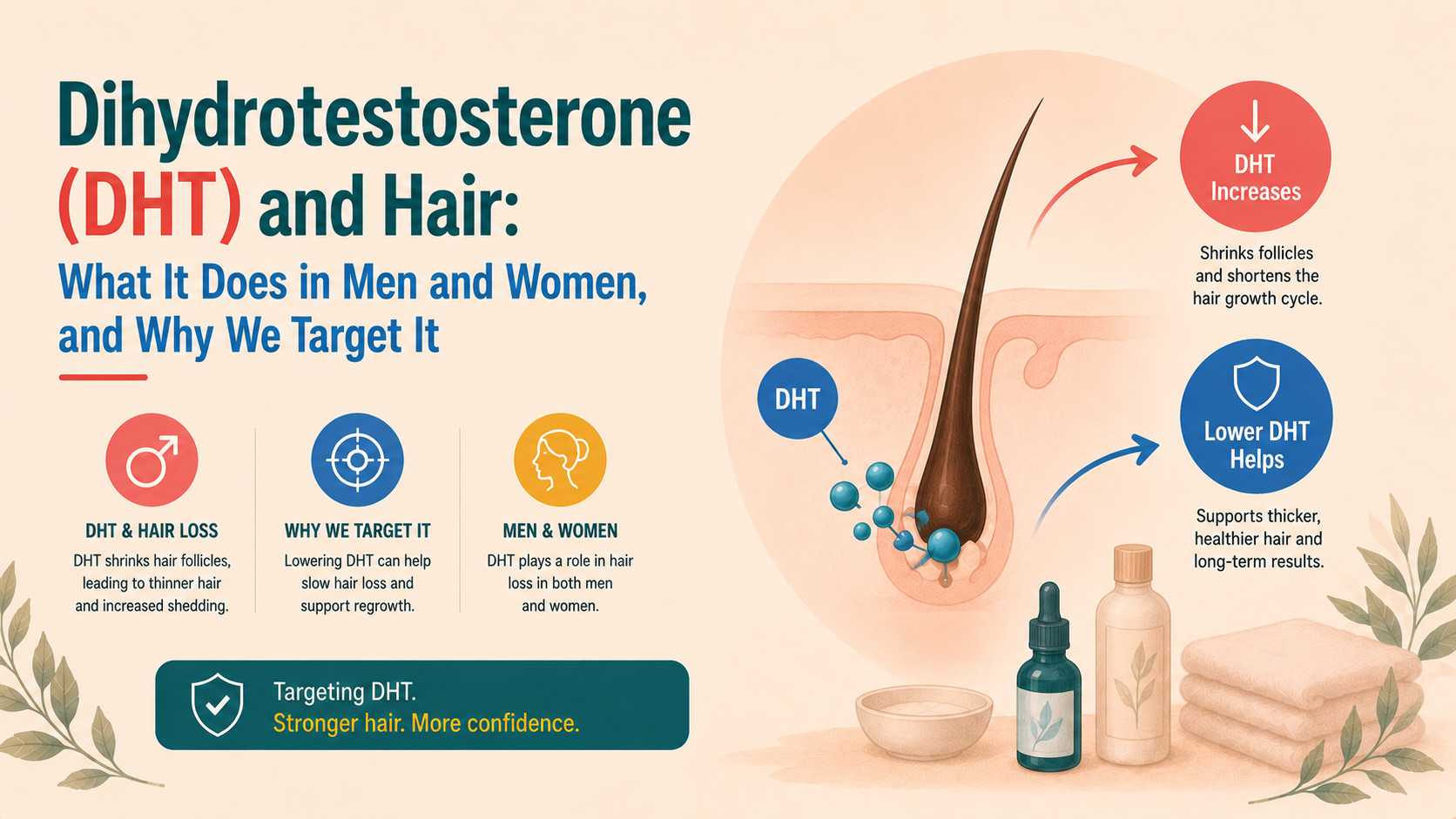
A potent androgen made from testosterone and strongly linked to male pattern hair loss.
Dihydrotestosterone, usually called DHT, is produced when 5-alpha reductase converts testosterone into a more potent androgen. In genetically susceptible scalp follicles, DHT signalling contributes to miniaturisation. This is why medicines that reduce DHT, such as finasteride and dutasteride, can slow male pattern hair loss. DHT is not simply a “bad hormone”; it has normal biological roles. The issue in pattern hair loss is follicle sensitivity in specific scalp regions. Female pattern hair loss may involve androgen pathways, but many women have normal androgen levels and require a more nuanced assessment.
British Association of Dermatologists: Hair loss male pattern (androgenetic alopecia) — https://www.bad.org.uk/pils/hair-loss-male-pattern-androgenetic-alopecia; Anastassakis K. Androgenetic Alopecia From A to Z, Vol. 1, Springer, 2022 — https://doi.org/10.1007/978-3-030-76111-0; Anastassakis K. Androgenetic Alopecia From A to Z, Vol. 2, Springer, 2022 — https://doi.org/10.1007/978-3-031-08057-9