1. Why hair loss is fertile ground for misinformation
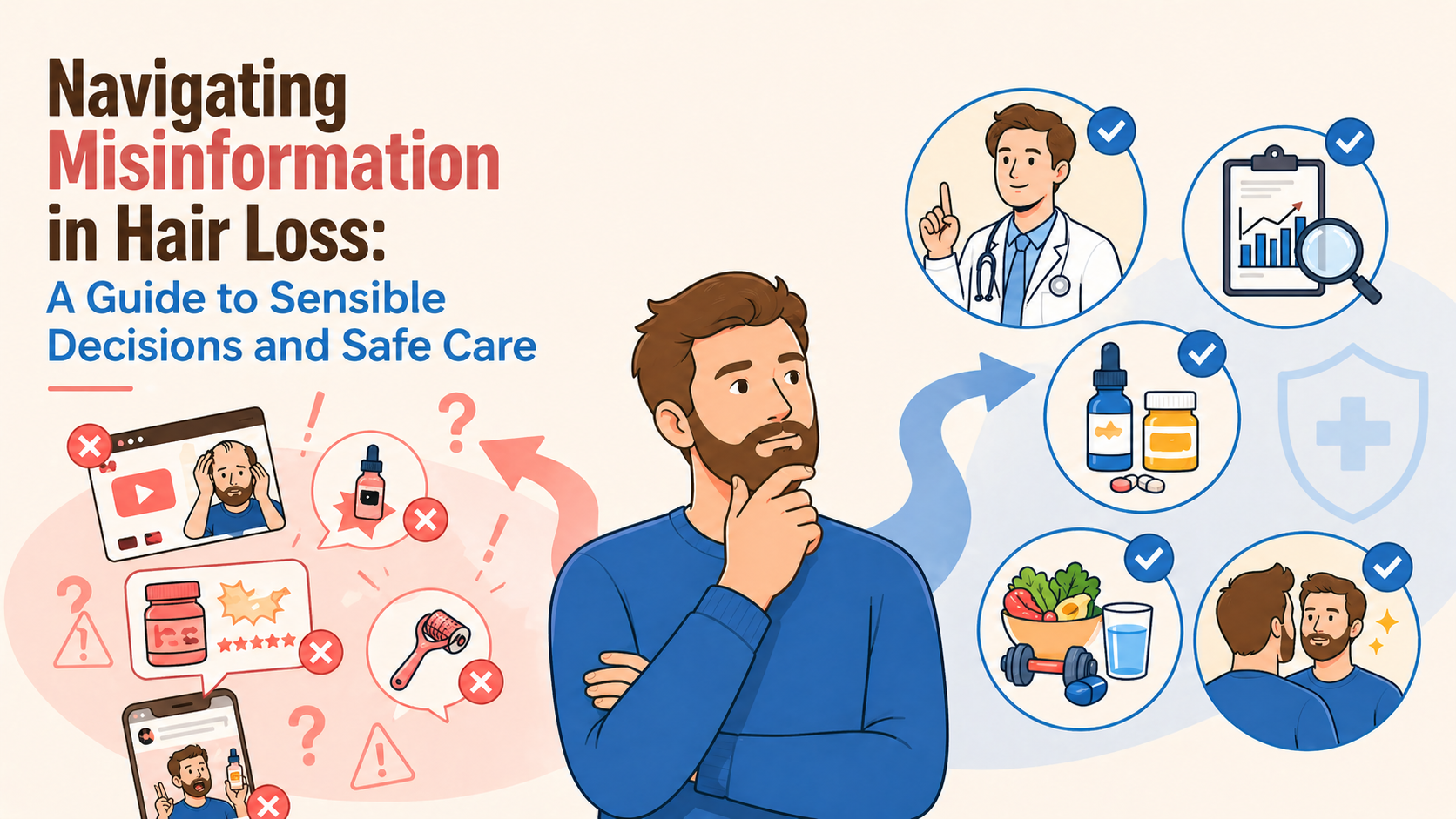
Several factors make hair loss a prime target for misinformation:
- It is common, visible and emotionally charged.
- It often begins at a relatively young age.
- Treatments are long-term, incremental and rarely definitive.
- There is a mixture of medical, surgical, cosmetic and “wellness” approaches; some evidence-based, some not.
For people searching online, this landscape can feel chaotic. It is easy to find:
- persuasive “cure” stories with little data behind them;
- alarmist posts about side-effects that present rare events as inevitabilities;
- and clinics that emphasise speed and volume rather than safety and donor preservation.
The aim here is not to make you cynical, but to give you tools to distinguish signal from noise.
2. Common patterns of misinformation and fearmongering
Misinformation around hair loss tends to fall into a few recurrent patterns.
2.1 Miracle cures and “hair loss solved”
These messages often:
- promise complete regrowth or “reversal” regardless of cause;
- rely heavily on before–after photos without context (lighting, styling, timeframes);
- use phrases such as “cure”, “permanent solution” or “guaranteed results”.
Red flags include:
- lack of clear diagnosis (the same product purported to treat pattern loss, scarring alopecia and alopecia areata);
- no mention of limitations, side effects, or the need for maintenance;
- absence of peer-reviewed studies, with only testimonials offered as evidence.
2.2 Extreme risk narratives
At the other end of the spectrum are fear-based stories that portray established treatments as inherently dangerous or “life-ruining”, for example:
- insisting that finasteride or dutasteride inevitably cause permanent sexual dysfunction (commonly known as post-finasteride syndrome) and psychiatric illness;
- claiming that minoxidil irreversibly “destroys the scalp” or “ages the face”;
- conflating rare adverse events with common outcomes.
While side effects are real and must be taken seriously, high-quality trials and systematic reviews typically show:
- modest absolute increases in risk, not inevitabilities;
- side effects that, in most patients, resolve with dose adjustment or discontinuation;
- and important benefits in slowing disease progression.
Ignoring the data in either direction – over-promotion or over-fear – distorts decision-making.
2.3 Pseudo-technical jargon
Some messages wrap weak claims in impressive-sounding language:
- “stem cell activation”,
- “DNA repair”,
- “detoxifying DHT receptors”,
- “epigenetic reset of follicles”.
Without clear references and clinical data, these phrases are just marketing. Genuine science is complex, but it is also transparent; you should be able to trace bold claims back to specific studies in recognisable journals.
3. Using an evidence lens: how to evaluate what you read
You do not need to be a researcher to apply a simple evidence lens.
Helpful questions include:
- Who is providing this information?
- Is it a national dermatology society, a university, a recognised expert, a patient charity, or a commercial entity selling a product?
- What is the basis for the claim?
- Are there references to controlled trials, guidelines or systematic reviews, or only personal anecdotes?
- Is a diagnosis clearly specified?
- Advice that lumps all hair loss together is inherently imprecise. A treatment that works for telogen effluvium may be inappropriate for scarring aloecia and vice versa.
- Are limitations and uncertainties acknowledged?
- Real medicine includes phrases like “in some patients”, “modest improvement” and “ongoing monitoring is required”; it does not speak in absolutes and acknowledges uncertainty.
- Is the language balanced or absolute?
- Words like “always”, “never", and "guaranteed” tend to be more characteristic of marketing than science; again, researchers acknowledge how irresponsible this phrasing can be, since their work is eventually aggregated to guide real-world treatment.
When in doubt, looking up a drug or procedure on the website of a dermatology society or in a guideline is often more informative than an hour of forum reading, albeit less emotionally engaging.
4. Social media and forums
Online communities can provide genuine peer support and practical tips. However, they are also shaped by platform dynamics:
- algorithms tend to amplify content that is emotive, polarising or visually striking;
- people are more likely to post when they have extreme experiences, very good or very bad, than when their outcome is average (and these tend to get more likes and upvotes);
- nuance and probability rarely go viral.
It can help to use forums for lived experience rather than epidemiology: personal stories are valuable for understanding what a treatment feels like, how people cope with side effects, and how they integrate hair loss into their lives; however, they are not reliable for estimating how common an outcome is or whether a given treatment works on average.
If reading forums leaves you more fearful than informed, it may be time to step back and rebalance your information diet towards more structured sources.
5. Recognising problematic clinics and practices
Clinic marketing can be a major source of misinformation. Certain patterns warrant caution.
5.1 Over-promising and under-explaining
Warning signs include:
- emphasis on cosmetic language (“scarless”, “no surgery”, “lunchtime procedure”) without a meaningful explanation of risks;
- large promised graft numbers or density without discussion of donor limitations;
- guarantees of specific outcomes (“full restoration”, “youthful hairline”) rather than ranges or probabilities.
A robust consultation should include:
- an examination and clear diagnosis;
- an estimate of donor capacity and long-term planning;
- a discussion of alternative approaches, including medical and non-surgical options.
5.2 Heavy reliance on technicians and transplant tourism
International societies have voiced concerns about:
- high-volume clinics where much of the procedure is delegated to unlicensed technicians;
- “package” surgeries abroad that combine travel, accommodation and large FUE sessions at very low cost;
- variability in pre-operative assessment, follow-up and complication management.
Risks in such settings include over-harvesting that leaves donor areas depleted, higher transection rates with lower graft survival, and limited recourse if complications arise.
Cost is a legitimate factor, but when major surgery is offered at a fraction of the usual price, it is worth asking where the compromises lie.
5.3 Pressure and urgency
High-pressure tactics – “limited-time discounts”, “book today”, “prices increasing next month” – are not compatible with considered, long-term planning for a chronic condition. A clinic that respects your decision-making will allow you time to think, ask questions and seek other views.
6. Constructive scepticism about “new” and “cutting-edge”
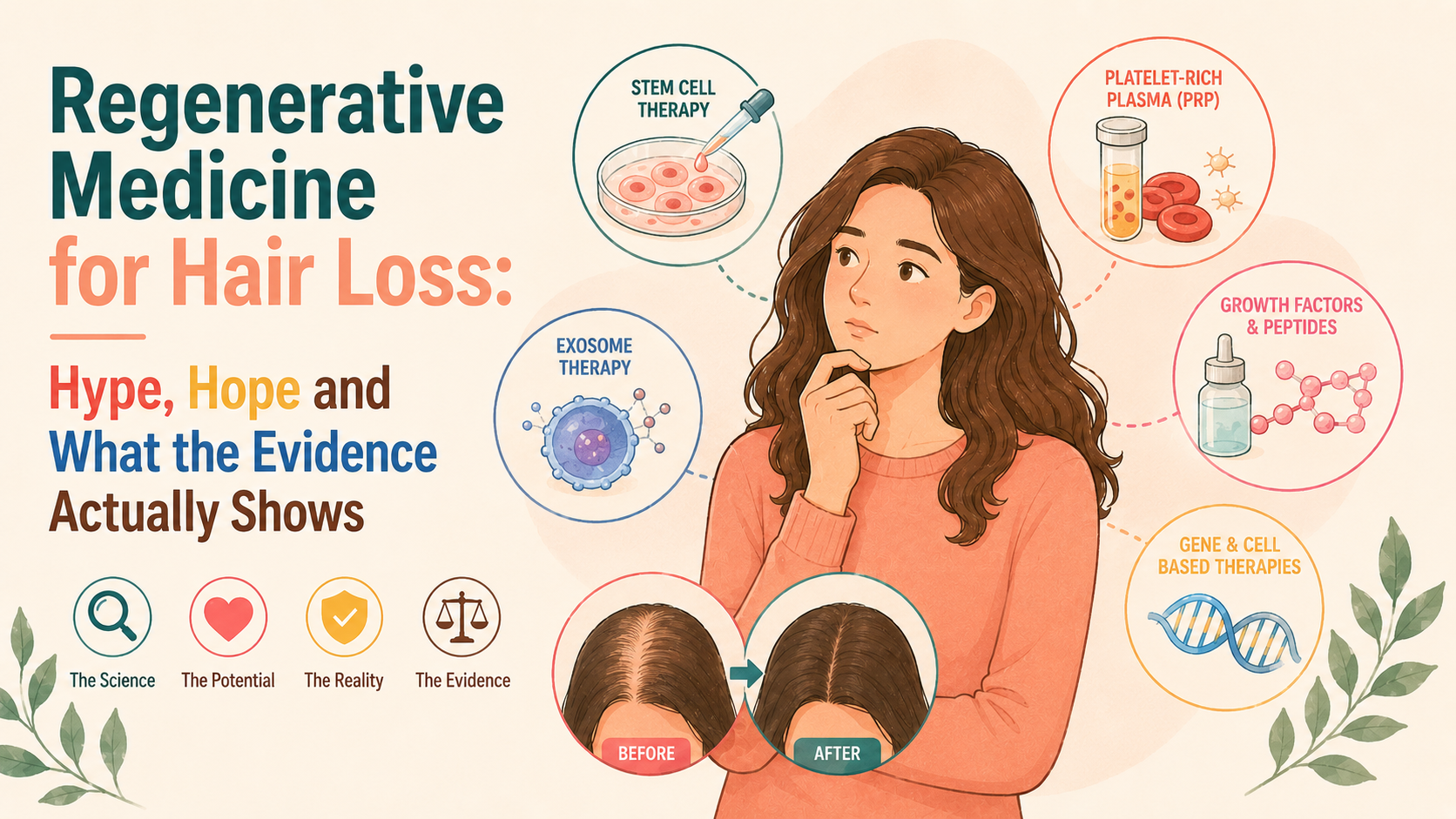
Regenerative techniques, exosomes, stem cell-derived products and novel devices are exciting areas of research, and it is reasonable to be interested in them. At the same time:
- not all offerings marketed as “stem cell therapy” or “exosomes” are supported by robust clinical data;
- regulatory classifications vary by country, and some products fall into grey zones;
- long-term safety and durability for newer modalities are, by definition, not yet fully known.
When a new technique is proposed, useful questions include:
- Is this part of a clinical trial or routine practice?
- What published human studies support its use in my specific type of hair loss?
- What are the known risks, and what is unknown?
- How will we judge if it has worked, and over what timeframe?
An intervention can be promising and worth exploring, but it should not be insulated from the same questions we ask of older treatments.
7. Balancing awareness of risk with avoidance of fear
Well-managed medical information does two things at once: it acknowledges and quantifies risk, and it sets that risk against potential benefit in proportionate terms.
For example, high-quality data on finasteride and dutasteride show:
- clear efficacy in slowing male pattern hair loss;
- an increased risk of sexual side-effects compared with placebo, but in absolute terms, affecting a minority;
- rare but serious mood-related side-effects, enough to prompt regulatory warnings but not so common that they preclude use in all men.
A balanced view, therefore, neither minimises side effects (“these drugs are completely safe”) nor inflates them (“no man should ever take these drugs”).
Similarly, surgery has complications and consequences; PRP and regenerative therapies have costs and uncertainties; supplements have limited benefits and, in some cases, potential for harm at high doses. Understanding these within realistic ranges allows for informed choice, rather than decisions based on headline anecdotes.
8. Building your own “information filter”
You do not need to become an expert to protect yourself from misinformation, but you can actively curate what you pay attention to.
Some practical steps:
- Identify a small set of trusted medical sources: national dermatology societies, patient charities, academic centres, and clinicians whose work you respect. Default to these when you are unsure.
- Use forums and social media primarily for peer support and lived experience, not for deciding what is true in a statistical sense.
- When you encounter a dramatic claim, positive or negative, pause and ask: is this a single story (anecdote), or is it supported by evidence (data)? The plural of anecdote is not data.
- If you feel more frightened after reading about hair loss than before, consider limiting exposure for a period and reorienting to calmer sources.
- Or better, consult with an expert who has the patient's best interests at heart rather than clear financial motivations.
Over time, this filter becomes a habit. You begin to recognise familiar patterns of exaggerated marketing or alarmism, and they start to lose some of their power.
9. A brief summary of “do” and “be cautious about”
- It is valuable to seek early medical assessment from a general practitioner or dermatologist when you notice persistent hair loss, particularly if there are red flags.
- It is appropriate to expect that any treatment – drug, device, supplement or surgery – can be discussed in terms of both benefits and risks, with citations if you want them.
- It is wise to be cautious of any message that promises a cure, insists that a single intervention is the only acceptable path, or frames your worth as dependent on your willingness to undergo that intervention.
- It is legitimate to weigh your own values – about appearance, health, risk, cost and effort – as highly as numerical efficacy when deciding what to do.
You are not obliged to pursue every available treatment to be “serious” about your hair, nor to refuse treatments that could help because of isolated horror stories. The middle ground is where most steady, sustainable decisions are made.

![[headshot]](https://cdn.prod.website-files.com/68207da82e5b8c350c67932f/68c6a7436a552c0fe87a4da7_Screenshot%202024-11-27%20at%2011.38.11.png)