1. Why does the distinction matter?
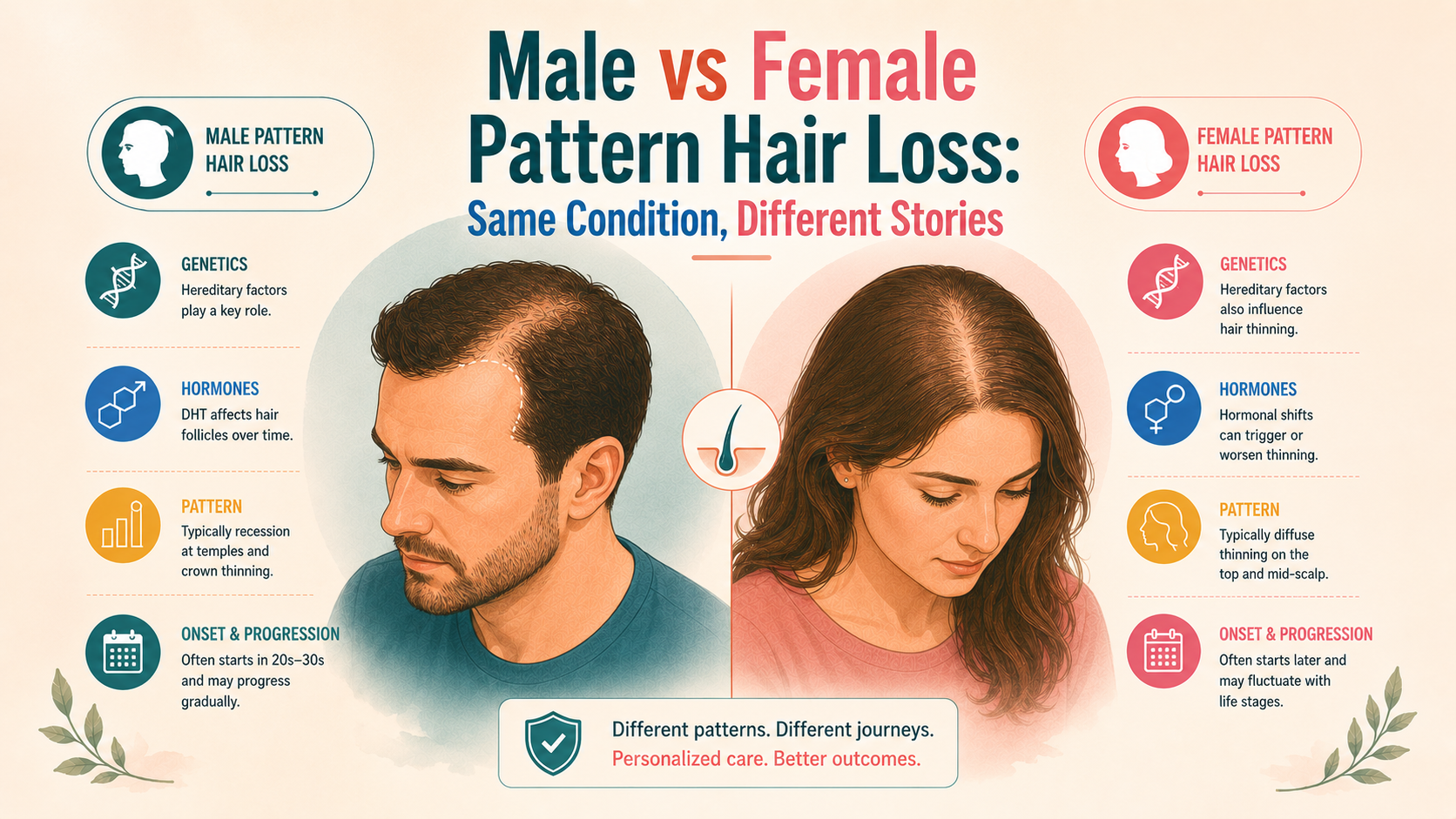
Androgenetic alopecia is by far the most common cause of long-term thinning in both sexes. It is tempting to treat it as a single entity with minor cosmetic differences between men and women. In reality, the differences are clinically and emotionally significant.
Men are more likely to develop obvious balding at a younger age, while women more often experience diffuse thinning without complete loss. The hormonal context, associated conditions and treatment options differ in important ways.
Understanding both the similarities and the differences helps patients make sense of their own experience, and helps clinicians avoid a copy-and-paste approach that may not be appropriate for women.
2. Shared biology: a common core
At its core, androgenetic alopecia in both sexes reflects:
- Genetic susceptibility of certain follicles.
- Exposure to androgens, especially dihydrotestosterone (DHT).
- Progressive miniaturisation of hair follicles in specific scalp regions.
- Altered hair cycling, with shortened growth phases and a higher proportion of follicles in resting or shedding phases.
In both men and women:
- DHT is produced from testosterone by the enzyme 5α-reductase within scalp tissue.
- DHT binds to androgen receptors in susceptible follicles and alters the expression of growth-related genes.
- Over repeated cycles, the affected follicles gradually shrink. They produce thinner, shorter hairs until some eventually stop producing visible hairs at all.
So the fundamental pathophysiology is shared. The differences arise from sex-specific hormonal environments, scalp patterning, and how these processes play out over decades.
3. How patterns differ on the scalp
3.1 Men: hairline, crown and the “horseshoe”
In men, androgenetic alopecia typically follows the Hamilton–Norwood pattern:
- Early changes often begin at the frontal hairline and temples, creating recession.
- Vertex thinning develops at the crown, with a circular area of reduced density.
- Over time, the frontal and vertex zones may merge, leaving a rim of hair around the sides and back of the scalp – the familiar “horseshoe”.
This pattern reflects the varying sensitivity of follicles: frontal and vertex follicles are highly androgen-responsive; occipital follicles are relatively resistant.
3.2 Women: central thinning and the “Christmas-tree” pattern
In women, the pattern is described using the Ludwig or Sinclair scales:
- The frontal hairline is usually preserved.
- Thinning appears as a widening of the central part and reduced density across the mid-scalp and crown.
- When the hair is parted from the front, the area of worst thinning sometimes resembles a Christmas tree, with central loss extending further back than the lateral areas.
Complete baldness in women is rare. The overall effect is one of diffuse reduction in volume rather than defined bald patches.
3.3 Practical impact
These pattern differences affect:
- How early hair loss is noticed. Men may see their hairline recede in their twenties. Women may not recognise central thinning until it has been present for years.
- How hair can be styled to conceal thinning. Longer hairstyles and hairlines preserved in women allow for more camouflage, but also mean that hair loss can be dismissed as “normal ageing” for longer.
4. Hormonal environment: same molecules, different context
4.1 Men
In most men with androgenetic alopecia:
- Serum testosterone and DHT levels are within the normal male range.
- What differs is the local activity of 5α-reductase and the sensitivity of androgen receptors in scalp follicles.
- There is often a positive family history, and pattern hair loss tends to progress gradually from the late teens or twenties onwards.
Systemic androgen levels are sufficient to drive the process once the genetic susceptibility is present.
4.2 Women
In women, the picture is more nuanced:
- Many women with female pattern hair loss have normal serum androgen levels.
- Follicular sensitivity and local androgen metabolism again play a central role.
- A subset of women have clinical or biochemical hyperandrogenism (for example, in polycystic ovary syndrome), where elevated androgens can accelerate thinning, increase body hair, and contribute to acne and menstrual irregularities.
- Around menopause, lower oestrogen levels change the balance between oestrogens and androgens, often unmasking or worsening underlying female pattern hair loss.
Hormones are therefore more closely linked to broader health contexts in women, including reproductive health, metabolic health, and the menopausal transition.
5. Genetics and family patterns
Both male and female pattern hair loss demonstrate strong familial clustering. However, the expression differs:
- Men often recognise male relatives with similar recession or vertex patterns.
- Women may see thinning in mothers, maternal aunts or grandmothers, but it may be less openly discussed or noticed because overt baldness is uncommon.
Genetic studies show shared risk loci (including the androgen receptor gene region) but also sex-specific associations. In practice, a family history of early-onset male pattern baldness can be a clue to risk in daughters as well as sons, even if the pattern appears different on the scalp.
6. Time course and prognosis
6.1 Age of onset
- Men frequently notice early changes in their late teens or twenties; more severe forms can progress substantially by the thirties.
- Women often present later. Thinning can begin in the twenties or thirties but may not be recognised until volume loss becomes more significant in the forties or at menopause.
6.2 Rate and extent of progression
- Men are more likely to progress to advanced baldness if the process starts early and is not treated.
- Women tend to show chronic, slowly progressive thinning, with partial preservation of coverage even in later life.
6.3 Psychological profile
Studies consistently show that both men and women experience psychological impact, but women often report higher distress at similar objective severity. Social expectations and perceived “normality” of male baldness versus female thinning are likely to play a role.
7. Assessment: what clinicians look for in men vs women
The core elements of assessment are similar in both sexes:
- A detailed history (onset, tempo, triggers, family history).
- Examination of pattern, density and scalp health.
- Dermoscopy (trichoscopy) to evaluate miniaturisation and rule out scarring causes.
However, there are sex-specific considerations.
In men
- Diagnosis of pattern hair loss is often straightforward based on clinical pattern and dermoscopy.
- Routine blood testing is not always required in a typical case without systemic symptoms.
- The main question is whether this is isolated androgenetic alopecia or whether another concurrent process (e.g., diffuse shedding after illness) is present.
In women
Assessment usually goes a little further:
- The pattern may be less specific early on. Trichoscopy becomes particularly useful.
- Blood tests are more commonly considered, especially when there is significant shedding, irregular periods, hirsutism or weight change. These might include ferritin, thyroid function, vitamin D, and androgen panel when indicated.
- It is important to distinguish female pattern hair loss from chronic telogen effluvium and from scarring alopecias that can mimic diffuse thinning - a biopsy may be indicated here.
In short, men are often “pattern first, test selectively”; women are more often “pattern plus context, test where clinically indicated”.
8. Treatment differences in practice
The broad therapeutic tools include minoxidil, agents that affect androgen pathways, adjunctive procedures, and surgery. The details, however, differ between men and women. This is discussed in more detail in a separate article on Treatment Options in Women.
8.1 Minoxidil: equal opportunity
Topical minoxidil is used in both sexes:
- 5% or 2% solutions or foam, adjusted to tolerability and preference.
- Mechanism and expectations are essentially the same: prolong anagen, thicken miniaturised hairs, reduce shedding.
Low-dose oral minoxidil is emerging as an option in both men and women where topical therapy is unsuitable, but dosing and risk discussion may differ with cardiovascular status and pregnancy planning.
8.2 Androgen-modifying drugs
In men:
- Finasteride 1 mg daily and dutasteride 0.5 mg daily (off-label) are widely used to lower DHT and slow or reverse miniaturisation.
- These are generally long-term treatments and can be combined with topical minoxidil.
- The main caveats are potential sexual side effects and the need to avoid handling crushed tablets in women of childbearing age.
In women:
- Finasteride and dutasteride are more complex. They are teratogenic and contraindicated in pregnancy.
- They may be considered in post-menopausal women, or in pre-menopausal women using reliable contraception, under specialist guidance.
- Anti-androgens such as spironolactone and cyproterone acetate are more commonly used in women, especially where hyperandrogenism is present. These require counselling about menstrual irregularities, potential side effects and contraception.
The broad principle is that systemic androgen-modifying therapy in women must always be considered in the context of reproductive health and wider endocrine risk. In contrast, for men, it is more straightforward, with the primary focus on efficacy, tolerability, and individual risk tolerance.
8.3 Procedures and surgery
Hair transplant surgery is used in both sexes, but with different design priorities:
- In men, transplantation aims to restore or reinforce hairlines and crowns in a way that remains age-appropriate as loss progresses. Planning the long-term pattern is crucial.
- In women, donor and recipient sites can be more complex due to diffuse thinning and preservation of the hairline. Transplantation is most effective in women with more localised frontal or mid-scalp thinning and a stable donor area.
Adjunctive procedures such as microneedling, platelet-rich plasma and low-level laser therapy do not differ substantially by sex, though expectations and aesthetic goals often do.
9. Key differences at a glance
To draw the threads together:
- Biology
- Shared core mechanism in both sexes: genetically susceptible follicles responding to androgens.
- Hormonal context in women is more closely associated with menstrual, metabolic, and menopausal status.
- Pattern
- Men: recession and vertex loss, with potential for advanced baldness.
- Women: central thinning and preserved hairline, with chronic reduction in volume rather than complete loss.
- Assessment
- Men: pattern recognition is usually sufficient; tests tailored to clinical suspicion.
- Women: more frequent need to consider iron status, thyroid function, androgen excess, plus differential diagnoses.
- Treatment
- Minoxidil is central in both.
- Finasteride and dutasteride are straightforward options in men; in women, they require more caution and often give way to other anti-androgens.
- Surgical planning differs, reflecting patterns and expectations.
Recognising these differences helps ensure that men and women receive care aligned with their biology, risk profiles, and goals, rather than a one-size-fits-all approach based solely on a shared label.

![[headshot]](https://cdn.prod.website-files.com/68207da82e5b8c350c67932f/68c6a7436a552c0fe87a4da7_Screenshot%202024-11-27%20at%2011.38.11.png)