Join the Newsletter
Postpartum (post-pregnancy) hair loss is relatively common, often dramatic, and almost always temporary. This article explains why it happens, what a normal postpartum shed looks like, when it might be unmasking an underlying problem, and how to support your hair through the first year after birth.
![[headshot]](https://cdn.prod.website-files.com/68207da82e5b8c350c67932f/68c6a7436a552c0fe87a4da7_Screenshot%202024-11-27%20at%2011.38.11.png)
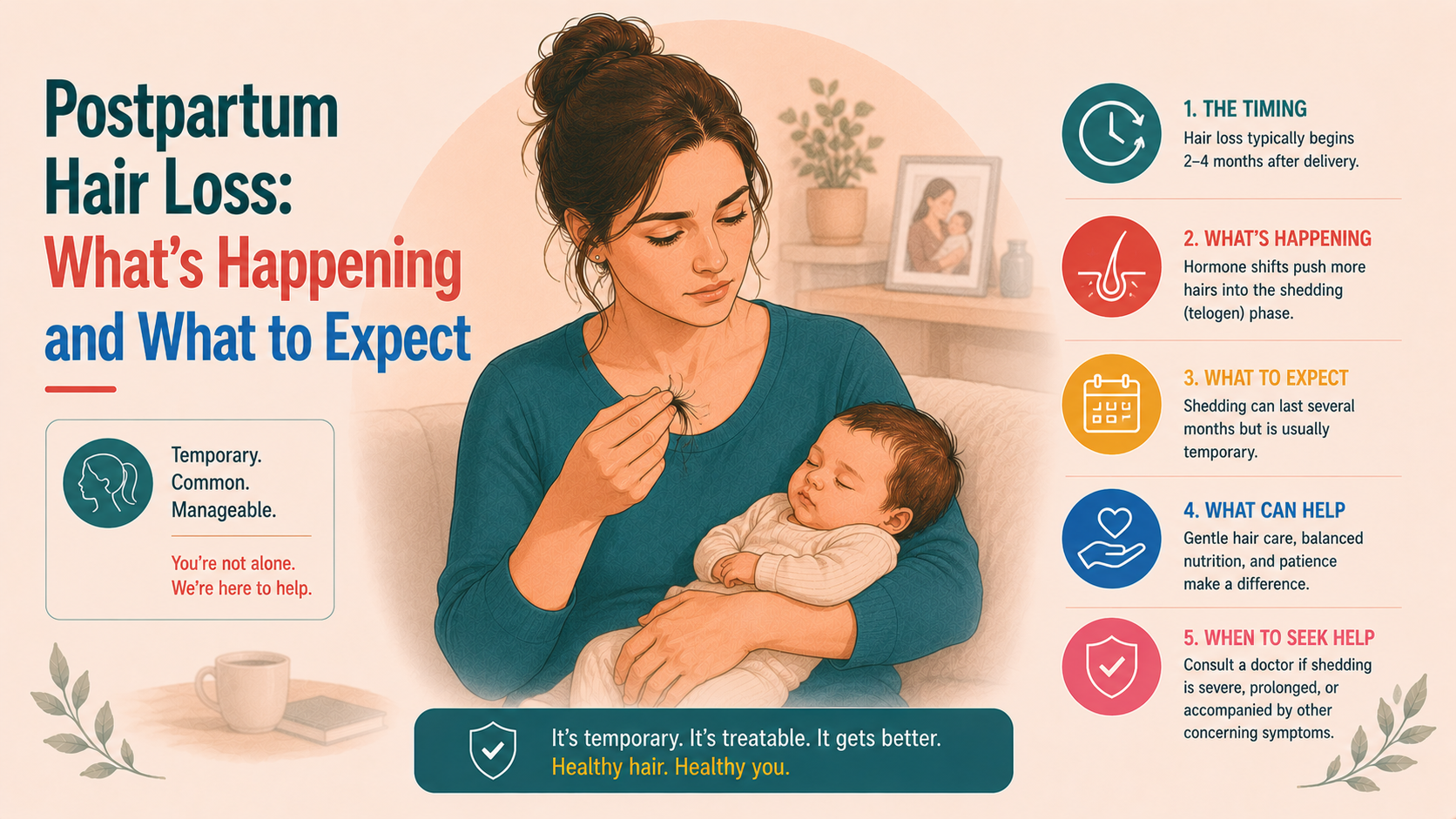
For women suffering postpartum hair loss, the months after birth bring a strange contradiction. Friends and family are celebrating the new baby, but every shower and hair wash feels like a minor crisis. Clumps of hair appear in the drain, the hairline looks thinner, and it is easy to fear that this is the start of permanent baldness.
Postpartum shedding can certainly be dramatic, but it is rarely a sign that something has gone irreversibly wrong. In most cases, it reflects the hair follicles’ delayed response to major hormonal shifts and physical stress. Understanding that biology turns a frightening experience into something more tolerable: an inconvenience rather than a personal catastrophe.
The term doctors often use is postpartum telogen effluvium (Latin translation: post-pregnancy hair-follicle-resting-phase shedding). It refers to a temporary increase in shedding that occurs in the months after delivery.
Key features:
Postpartum telogen effluvium is a specific example of a broader process: hair follicles synchronously shifting into a resting (telogen) phase and then shedding (exogen), often in response to a major systemic event.
To understand the postpartum shed, it helps to know how pregnancy affects the hair cycle.
In many pregnancies, women notice that their hair feels thicker, shinier and more robust. This is not imagined. Under the influence of high oestrogen and other pregnancy hormones:
Visually, this can translate into increased volume, fewer hairs in the shower, and a generally “better hair” experience.
Following delivery (and sometimes after cessation of breastfeeding), hormone levels change:
Because telogen lasts a few months, there is a lag between the hormonal change and the onset of visible shedding. When telogen hairs eventually enter the exogen phase and shed, the result can be a sudden, conspicuous increase in hair loss.
From the follicle’s perspective, this is a return to its regular cycling rhythm after a pregnancy-induced pause. From a new mother’s perspective, it can look and feel like an aggressive attack on her hair.
Typical postpartum shedding:
The overall scalp pattern tends to remain intact. The parting may look more pronounced and the ponytail thinner, but the hairline itself is preserved. There is no shiny, scarred skin, and no well-defined, circular patches as one would see in alopecia areata.
Many women also have less time and energy for styling, colouring or regular trims in the postpartum period, which can make hair feel duller or more lifeless, independent of actual density.
Postpartum hair loss is, biologically, a telogen effluvium:
In a classic telogen effluvium, the follicles themselves are not destroyed. They simply pause production and later re-enter the growth phase. That is why, given enough time and removal of the driving stress, regrowth is usually good.
Important nuance: in some women, an underlying androgenetic alopecia (female pattern hair loss) is present but not clinically obvious. The postpartum telogen effluvium can temporarily “strip out” their hair volume and unmask this underlying pattern. In such cases, hair regrowth may not fully return to perceived pre-pregnancy levels, and ongoing thinning of the mid-scalp may persist beyond one year.
Reassuring features:
In this scenario, the process usually reflects the physiological resetting of the hair cycle.
There is no need to wait in distress for a year if something does not feel right. It is sensible to ask for a professional review if:
A good clinician will consider the possibility not only of postpartum telogen effluvium but also of pattern hair loss, nutritional factors, and thyroid status.
Pregnancy and childbirth are not isolated events. Several other factors commonly present in the postpartum period can add to the burden on follicles:
These do not negate the normal hormonal story, but they can turn a mild, self-limiting telogen effluvium into a more pronounced or prolonged one.
For a typical, otherwise well woman with classic postpartum shedding and no red flags, a careful history and examination may be all that is required.
Clinicians may ask about:
Examination focuses on:
Blood tests are not mandatory in every case, but may be considered when:
Common investigations include a full blood count, ferritin, thyroid function tests, and vitamin D, tailored to the clinical picture.
The mainstay of treatment for uncomplicated postpartum telogen effluvium is time. Once the triggering hormonal and physical stresses have passed, follicles gradually return to their usual cycling behaviour.
Understanding that this is a delayed, physiological response rather than an ongoing, progressive disease can reduce a great deal of anxiety.
Although no lifestyle measure can instantly switch off a telogen effluvium, the following support the scalp in doing what it is designed to do:
For most women, strong hair-specific medication is not necessary for pure postpartum telogen effluvium.
The key distinction is between a transient shedding episode and a chronic underlying condition. The former needs support and time. The latter may benefit from targeted long-term treatment, but that decision need not be made in the immediate postpartum period.