Women's Hair Loss

Postpartum Hair Loss: What’s Happening and What to Expect

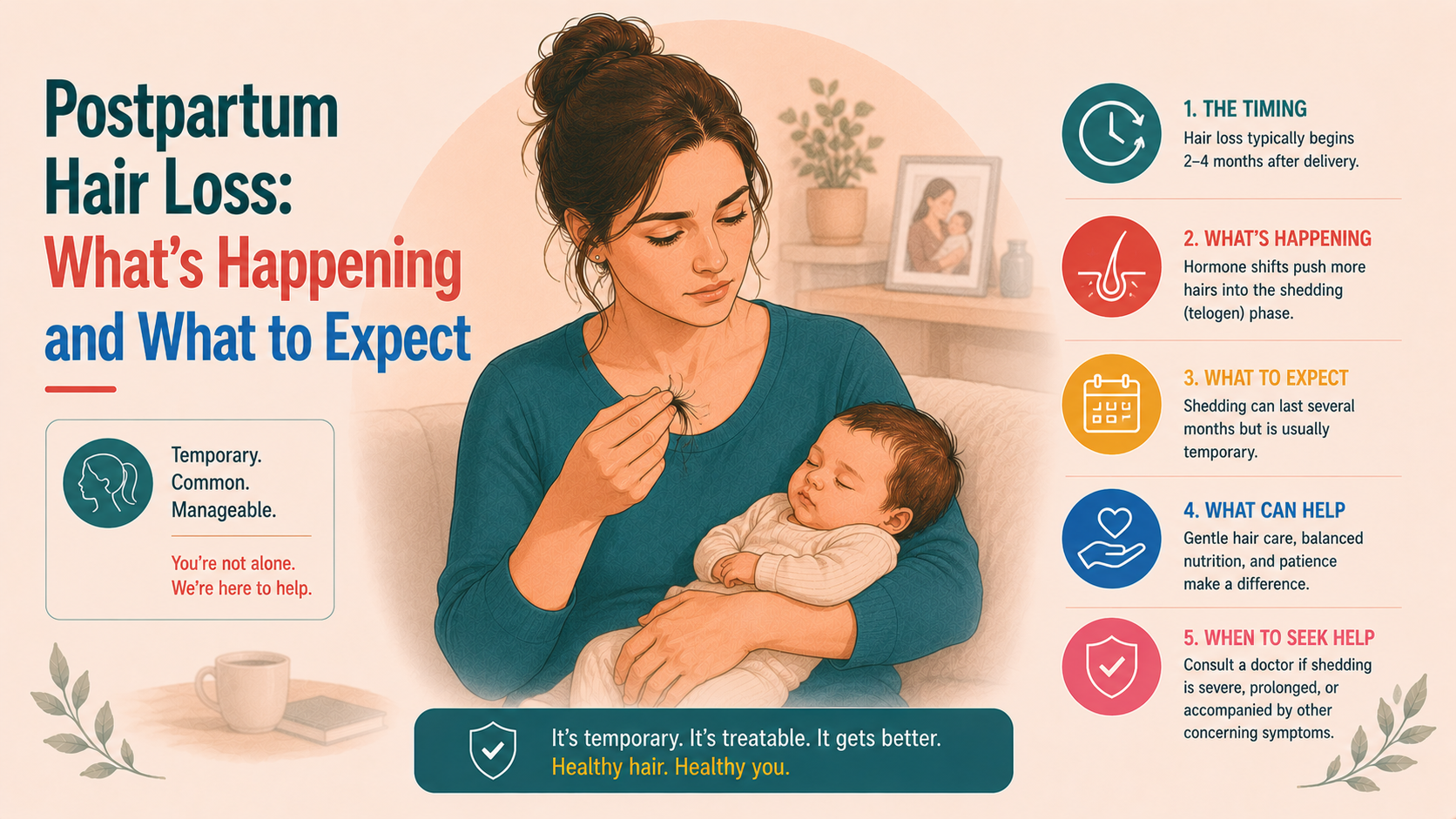
Postpartum (post-pregnancy) hair loss is relatively common, often dramatic, and almost always temporary. This article explains why it happens, what a normal postpartum shed looks like, when it might be unmasking an underlying problem, and how to support your hair through the first year after birth.

[headshot]
Dr. Harry M Griffiths
Article Summary

1. Why postpartum hair loss feels so alarming

For women suffering postpartum hair loss, the months after birth bring a strange contradiction. Friends and family are celebrating the new baby, but every shower and hair wash feels like a minor crisis. Clumps of hair appear in the drain, the hairline looks thinner, and it is easy to fear that this is the start of permanent baldness.

Postpartum shedding can certainly be dramatic, but it is rarely a sign that something has gone irreversibly wrong. In most cases, it reflects the hair follicles’ delayed response to major hormonal shifts and physical stress. Understanding that biology turns a frightening experience into something more tolerable: an inconvenience rather than a personal catastrophe.

2. What is postpartum hair loss?

The term doctors often use is postpartum telogen effluvium (Latin translation: post-pregnancy hair-follicle-resting-phase shedding). It refers to a temporary increase in shedding that occurs in the months after delivery.

Key features:

  • Appears two to four months after giving birth, sometimes a little later.
  • Shedding can be quite heavy for several weeks or months.
  • Hair is lost diffusely from the scalp rather than in discrete bald patches.
  • In the majority of women, shedding settles and density improves over six to twelve months.

Postpartum telogen effluvium is a specific example of a broader process: hair follicles synchronously shifting into a resting (telogen) phase and then shedding (exogen), often in response to a major systemic event.

3. Pregnancy, hormones and the hair cycle

To understand the postpartum shed, it helps to know how pregnancy affects the hair cycle.

3.1 During pregnancy

In many pregnancies, women notice that their hair feels thicker, shinier and more robust. This is not imagined. Under the influence of high oestrogen and other pregnancy hormones:

  • A larger proportion of follicles remain in anagen (the growth phase).
  • The transition into catagen and telogen is delayed.
  • Shedding is reduced.

Visually, this can translate into increased volume, fewer hairs in the shower, and a generally “better hair” experience.

3.2 After delivery

Following delivery (and sometimes after cessation of breastfeeding), hormone levels change:

  • Oestrogen levels fall back towards their pre-pregnancy state.
  • The hormonal prolongation of anagen is removed.
  • Many follicles that had been “held” in anagen now enter telogen together.

Because telogen lasts a few months, there is a lag between the hormonal change and the onset of visible shedding. When telogen hairs eventually enter the exogen phase and shed, the result can be a sudden, conspicuous increase in hair loss.

From the follicle’s perspective, this is a return to its regular cycling rhythm after a pregnancy-induced pause. From a new mother’s perspective, it can look and feel like an aggressive attack on her hair.

4. What does postpartum shedding look like clinically?

Typical postpartum shedding:

  • Begins around 2–4 months after birth (sometimes a little earlier or later).
  • Involves diffuse shedding across the scalp, though the frontal hairline and temples often seem most affected because hair is naturally finer there and styles expose these areas.
  • Produces large clumps of hair in the shower, on the pillow or in hairbrushes.
  • May last a few weeks to several months, but gradually improves.
  • Usually, it does not lead to complete bald patches.

The overall scalp pattern tends to remain intact. The parting may look more pronounced and the ponytail thinner, but the hairline itself is preserved. There is no shiny, scarred skin, and no well-defined, circular patches as one would see in alopecia areata.

Many women also have less time and energy for styling, colouring or regular trims in the postpartum period, which can make hair feel duller or more lifeless, independent of actual density.

5. Mechanism: telogen effluvium after pregnancy

Postpartum hair loss is, biologically, a telogen effluvium:

  • A larger than normal proportion of follicles enter telogen together in response to a systemic change (here, the end of pregnancy hormonal support, often combined with other stresses such as delivery, sleep deprivation and blood loss).
  • Telogen hairs then transition to the exogen phase and shed in a clustered fashion.

In a classic telogen effluvium, the follicles themselves are not destroyed. They simply pause production and later re-enter the growth phase. That is why, given enough time and removal of the driving stress, regrowth is usually good.

Important nuance: in some women, an underlying androgenetic alopecia (female pattern hair loss) is present but not clinically obvious. The postpartum telogen effluvium can temporarily “strip out” their hair volume and unmask this underlying pattern. In such cases, hair regrowth may not fully return to perceived pre-pregnancy levels, and ongoing thinning of the mid-scalp may persist beyond one year.

6. What is “normal” postpartum shedding, and when to worry?

6.1 Normal, self-limited postpartum shedding

Reassuring features:

  • Shedding begins within the expected window after birth.
  • Hair is falling from all over the scalp, without clearly bald areas.
  • The scalp skin itself looks healthy, without redness, burning, thick scale or pustules.
  • There is no significant loss of eyebrow or body hair.
  • Shedding peaks then slowly settles over several months, and regrowth can be seen as short, new hairs along the hairline and parting.

In this scenario, the process usually reflects the physiological resetting of the hair cycle.

6.2 When to seek assessment

There is no need to wait in distress for a year if something does not feel right. It is sensible to ask for a professional review if:

  • Shedding is very heavy and prolonged beyond six months without signs of improvement.
  • You notice clearly defined patches of total hair loss.
  • There is burning, intense itch, pain or visible inflammation of the scalp.
  • Your hair seems to be thinning predominantly in a patterned way through the mid-scalp and crown, while shedding continues.
  • You have other symptoms, such as fatigue, weight changes, palpitations, or changes in the skin and nails, that could suggest thyroid or nutritional problems.

A good clinician will consider the possibility not only of postpartum telogen effluvium but also of pattern hair loss, nutritional factors, and thyroid status.

7. Factors that can amplify postpartum shedding

Pregnancy and childbirth are not isolated events. Several other factors commonly present in the postpartum period can add to the burden on follicles:

  • Significant blood loss at delivery or postpartum haemorrhage, potentially contributing to iron deficiency.
  • Poor sleep and psychological stress, especially in the context of a difficult birth, premature baby or limited support.
  • Changes in diet: skipped meals, low appetite, or very restrictive eating in an attempt to lose pregnancy weight.
  • Thyroid dysfunction: postpartum thyroiditis can present with hyperthyroid and/or hypothyroid phases, both of which can affect hair.
  • New medications or contraceptives, including some progestin-only preparations, which in susceptible women may slightly worsen pattern hair loss.

These do not negate the normal hormonal story, but they can turn a mild, self-limiting telogen effluvium into a more pronounced or prolonged one.

8. How is postpartum hair loss assessed?

For a typical, otherwise well woman with classic postpartum shedding and no red flags, a careful history and examination may be all that is required.

Clinicians may ask about:

  • Timing of onset and progression of shedding.
  • The course of pregnancy and delivery (blood loss, complications).
  • Breastfeeding and menstrual status.
  • Diet, sleep, mood and medication changes.
  • Personal or family history of pattern hair loss or autoimmune disease.

Examination focuses on:

  • Pattern: diffuse versus patterned thinning, presence or absence of focal patches.
  • Scalp health: erythema, scale, scarring, follicular plugging.
  • Hair shafts under dermoscopy: diameter variability, miniaturisation, empty follicles.

Blood tests are not mandatory in every case, but may be considered when:

  • Shedding is unusually heavy or prolonged.
  • There are symptoms suggestive of anaemia or thyroid disease.
  • The clinician is concerned about overlapping conditions.

Common investigations include a full blood count, ferritin, thyroid function tests, and vitamin D, tailored to the clinical picture.

9. Management: what you can do and what time will do

9.1 The central treatment: time and reassurance

The mainstay of treatment for uncomplicated postpartum telogen effluvium is time. Once the triggering hormonal and physical stresses have passed, follicles gradually return to their usual cycling behaviour.

  • Shedding often peaks and then gradually declines.
  • New regrowth can be seen as short hairs along the frontal hairline and part line in the months that follow.
  • Many women find that by their baby’s first birthday, their hair density feels much closer to baseline, even if not identical.

Understanding that this is a delayed, physiological response rather than an ongoing, progressive disease can reduce a great deal of anxiety.

9.2 Supportive measures

Although no lifestyle measure can instantly switch off a telogen effluvium, the following support the scalp in doing what it is designed to do:

  • Nutrition: aim for regular meals with adequate protein and iron, and a generally varied diet. If iron deficiency or other deficiencies are identified, correcting these is important.
  • Gentle hair care: avoid excessive heat, harsh chemical treatments or tight hairstyles that tug at fragile regrowing hairs.
  • Stress management and sleep hygiene (within the realities of new parenthood): even small improvements can help overall recovery.

9.3 Role of medical treatments

For most women, strong hair-specific medication is not necessary for pure postpartum telogen effluvium.

  • Topical minoxidil can be considered in selected cases, particularly if postpartum shedding is unmasking underlying female pattern hair loss. Whether it is initiated and when depend on breastfeeding status, individual risk tolerance, and clinician judgement. There are a lack of data to support the safe use of minoxidil in breastfeeding.
  • Systemic treatments such as anti-androgens or 5α-reductase inhibitors are not used for simple postpartum telogen effluvium. They would only be considered in the context of confirmed pattern hair loss under specialist guidance, with careful attention to contraception and breastfeeding.

The key distinction is between a transient shedding episode and a chronic underlying condition. The former needs support and time. The latter may benefit from targeted long-term treatment, but that decision need not be made in the immediate postpartum period.
Read More from the Knowledge Hub:

Living with Hair Loss

Navigating Misinformation in Hair Loss: A Guide to Sensible Decisions and Safe Care

Hair loss sits at the intersection of emotion, identity, and commerce, making it particularly vulnerable to misinformation and aggressive marketing. This article offers a framework for evaluating what you read and hear, recognising unhelpful fear-based narratives, and spotting clinics and practices that may not have your long-term interests at heart.
Living with Hair Loss

When to Seek Professional Help for Hair Loss: An Educational Guide

Many people are unsure when hair loss is “normal” and when it warrants medical attention. This article outlines when it is reasonable to watch and wait, when early assessment is helpful, which red flags need prompt review, and who to see – from general practitioners to dermatologists and, in some cases, mental health professionals.
Living with Hair Loss

Finding Support with Hair Loss: Community, Psychological Help and Feeling Less Lost

Hair loss can be isolating, even though it is common. This article discusses where to find meaningful support, how to use communities and online spaces wisely, when it might be time to seek psychological help, and practical ways to feel less stuck and demotivated when you are living with ongoing hair changes.
Living with Hair Loss

Managing Expectations in Hair Loss: A Framework for Realistic, Hopeful Planning

One of the most important and under-discussed parts of treating hair loss is managing expectations. This article explores how hair loss typically behaves, what different treatments can and cannot reasonably achieve, the timelines involved, and how to approach conversations with clinicians and clinics so that hope is balanced with realism.