Women's Hair Loss

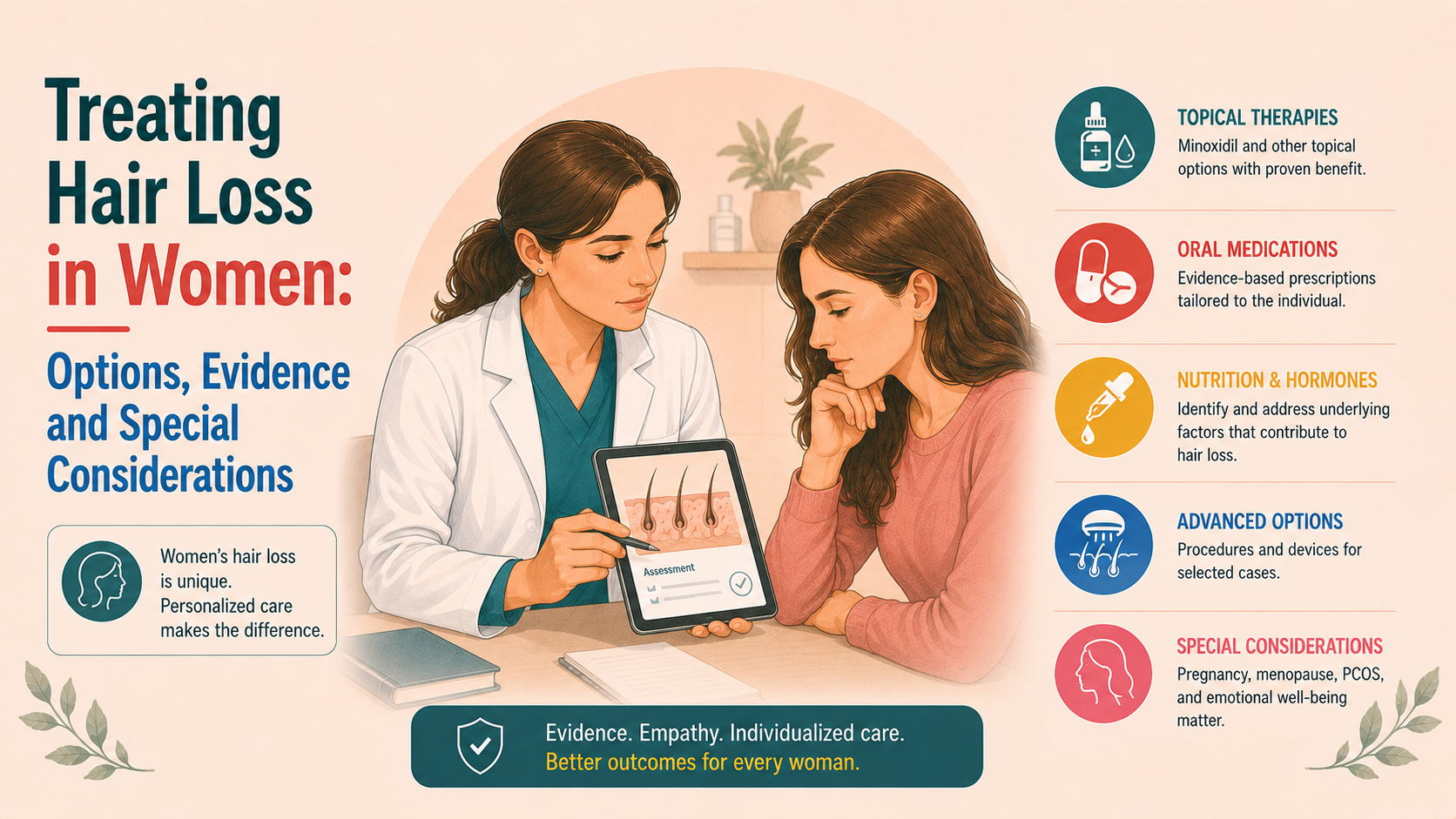
Treating Hair Loss in Women: Options, Evidence and Special Considerations

Women’s hair loss is relatively common, complex and often under-treated. This article explains the main treatment options for women – from topical and oral therapies to anti-androgens, adjunctive procedures and supportive care – with a focus on female pattern hair loss, but also touching on reactive shedding and scarring conditions where management differs.

[headshot]
Dr. Harry M Griffiths
Article Summary

1. Setting expectations: what treatment can reasonably achieve

The starting point with any treatment discussion is clarity.

For female pattern hair loss (FPHL), the most common chronic cause of thinning in women, treatment aims to:

  • slow or stabilise further miniaturisation
  • preserve and strengthen existing hair
  • support regrowth from follicles that are still viable
  • maintain coverage and volume as gracefully as possible over time

Treatment:

  • does not recreate adolescent density in all cases
  • does not regenerate hair from follicles that have been completely destroyed or replaced by scar tissue
  • requires months before benefit is obvious, and continues to work only while it is continued

For telogen effluvium, including postpartum shedding, the goal is often to identify and address triggers, support general health and allow the cycle to rebalance, rather than to force regrowth.

For scarring alopecias (such as frontal fibrosing alopecia or lichen planopilaris), the goal is to halt or slow inflammatory destruction of follicles. Regrowth in scarred areas is rarely possible.

With that in mind, we can discuss the treatment options for women which are currently used in practice.

2. Female pattern hair loss: the central therapeutic target

Most of the medical options described here are aimed primarily at FPHL. Other conditions have their own specific regimes, but the majority of women seeking treatment fall into this group.

2.1 Topical minoxidil: first-line for most women

How it works

Topical minoxidil prolongs the anagen (growth) phase of the hair cycle, encourages follicles to re-enter anagen more quickly after telogen, and improves local blood flow and growth factor signalling around the follicle.

Where follicles are still structurally present, the overall effect over time is reduced shedding, thicker shafts replacing miniaturised hairs, and a greater number of hairs in active growth at any given moment.

Formulations and use

For women, commonly used regimens include:

  • 2% solution applied twice daily, or
  • 5% solution or foam applied once daily, depending on tolerance and preference

The best formulation is the one a woman is willing and able to use consistently. Technique (small amounts spread evenly onto the scalp rather than poured onto the hair) and patience are as important as formulation strength.

What to expect
  • A transient increase in shedding in the first weeks is common, as follicles synchronise and older telogen hairs are shed.
  • Visible improvements in density or volume often take four to six months, sometimes longer.
  • Continued use is usually needed to maintain gains; stopping minoxidil tends to return follicles to their untreated trajectory over several months.
Side effects
  • Mild scalp irritation or itching, often manageable by changing vehicle or frequency.
  • Unwanted facial hair growth in a minority of women, particularly if the product runs onto the face; adjusting the application technique can minimise this.
  • Serious systemic effects are rare with topical use in standard doses.

2.2 Low-dose oral minoxidil

When topical minoxidil is ineffective, poorly tolerated, or impractical, low-dose oral minoxidil is an emerging option.

Advantages

  • avoids the cosmetic and practical issues of topical application
  • delivers systemic exposure that bypasses variability in scalp enzyme activation
  • can produce impressive regrowth and stabilisation in appropriately selected women

Cautions

  • potential side-effects include ankle swelling, increased body or facial hair, and occasionally postural lightheadedness or palpitations
  • requires careful dose selection, gradual titration and medical supervision
  • pregnancy and breastfeeding must be discussed, as data are limited, and risk–benefit must be considered individually

Low-dose oral minoxidil is not a first-line drug for every woman, but it is becoming an important option in specialist practice.

2.3 Anti-androgen therapy

In women, especially those with signs of hyperandrogenism (acne, hirsutism, irregular periods), anti-androgen therapycan play a central role.

Spironolactone:

  • blocks androgen receptors
  • reduces androgen production in the ovaries and adrenals
  • promotes a shift towards a less androgen-dominant environment at the follicle

It is commonly used in women at doses tailored to tolerance and blood pressure.

Points to consider:

  • Suitable contraception is essential, as spironolactone is not appropriate in pregnancy
  • Possible side effects include increased urination, breast tenderness, mild fatigue, and, in some cases, changes in blood pressure or potassium levels
  • It is often combined with topical minoxidil for FPHL and can be particularly helpful in women with PCOS or related hyperandrogenic states

Cyproterone acetate and other anti-androgens

Cyproterone acetate, another anti-androgen, may be used either cyclically with oestrogens (in certain contraceptive preparations) or alone in selected cases. In some countries, it is used more widely than in others.

Other anti-androgen strategies, including some combined oral contraceptives with anti-androgenic progestins, can modestly help hair in women with clear androgen excess, but their primary indication is usually contraceptive or gynaecological, with hair as a secondary benefit.

These treatments require individualised risk–benefit assessment, including breast and thrombotic risk, and must be prescribed with clear endocrine insight.

2.4 5α-reductase inhibitors: finasteride and dutasteride in women

Finasteride and dutasteride block conversion of testosterone to dihydrotestosterone (DHT). In men, they are cornerstones of androgenetic alopecia treatment. In women, their use is more nuanced.

In premenopausal women

  • These drugs are teratogenic and contraindicated in pregnancy due to risk of feminisation of a male fetus.
  • If used, they must be combined with reliable contraception and very clear counselling.
  • They are not first-line in most guidelines but can be considered in carefully selected women under specialist supervision when other therapies are insufficient.

In postmenopausal women

  • The concern around pregnancy is removed, but long-term safety still requires thought.
  • Some studies show benefit in postmenopausal women with FPHL at higher doses than those used in men, but data are more limited.
  • As always, risks and potential benefits must be weighed on a case-by-case basis.

Topical finasteride, alone or in combination with minoxidil, is being explored as a way to reduce scalp DHT with minimal systemic exposure. It may offer a safer middle ground in future, although long-term data are still emerging.

2.5 Other medical adjuncts

Ketoconazole shampoo

  • Often used a few times per week to treat seborrhoeic dermatitis, which commonly co-exists with hair loss.
  • Has mild anti-androgenic and anti-inflammatory effects on the scalp.
  • Can be a useful adjunct but is not a standalone treatment for FPHL.

Nutritional optimisation

  • Correcting iron deficiency, vitamin D deficiency, or other significant nutritional issues will not “cure” FPHL, but is essential to minimise reactive shedding layered on pattern loss.
  • Over-supplementation without documented deficiency contributes more to cost than to hair.

3. Treating reactive shedding in women

Not all hair concerns in women are pure FPHL. Many present with combinations of pattern loss and telogen effluvium.

3.1 Acute telogen effluvium

This often follows severe illness, major surgery, high fever, childbirth, miscarriage, termination, crash dieting, or sudden, intense stress.

Core management is to:

  • identify and, where possible, remove or treat the trigger
  • reassure that shedding reflects a delayed response rather than ongoing damage
  • support general health, nutrition, sleep and stress management

Topical minoxidil can be considered when telogen effluvium overlaps with FPHL, but in pure TE, time and trigger correction often suffice.

3.2 Postpartum telogen effluvium

As covered in detail in our separate postpartum article:

  • typically arises two to four months after birth
  • can be dramatic but usually self-limited
  • may unmask underlying FPHL

Here, treatment conversations revolve around providing reassurance and education, optimising nutrition (including iron, protein, and other key nutrients), and considering minoxidil only when underlying female pattern hair loss is present and, in women who are breastfeeding, when risk tolerance and individual circumstances have been carefully considered.

4. Treating scarring alopecias in women

Conditions like frontal fibrosing alopecia (FFA), lichen planopilaris (LPP), and central centrifugal cicatricial alopecia (CCCA) require a different therapeutic strategy because they involve inflammatory destruction of follicles.

4.1 General principles

  • Early, accurate diagnosis is crucial.
  • Treatment focuses on suppressing the inflammatory process, not on traditional “hair growth stimulation”.
  • Regrowth in scarred areas is unlikely; the aim is to stop the fire, not to rebuild burnt trees.

4.2 Therapeutic tools

Depending on the specific diagnosis, these may include:

  • potent topical corticosteroids
  • intralesional corticosteroid injections
  • topical calcineurin inhibitors
  • systemic agents such as hydroxychloroquine, doxycycline, isotretinoin, mycophenolate or other immunomodulators

FPHL-specific tools like finasteride or minoxidil can still play a role in preserving non-scarred follicles at risk, particularly in “mixed” patterns where FFA co-exists with FPHL.

Because these regimens are more complex and carry greater systemic implications, they should be managed by clinicians experienced in hair and scalp disease.

5. Procedural and device-based treatments

These are usually adjunctive to medical therapy rather than replacements.

5.1 Platelet-rich plasma (PRP)

In women with FPHL, PRP involves concentrating platelets from the patient’s blood and injecting them into the scalp to deliver a cocktail of growth factors that support hair follicles.

Some studies show improved hair density and thickness when PRP is used in series and combined with minoxidil or anti-androgens. Protocols and response rates vary, and it can be costly, so expectations should be realistic.

5.2 Microneedling

Microneedling in women:

  • uses fine needles to create micro-channels in the scalp
  • may stimulate wound-healing pathways helpful to follicles
  • can enhance penetration of topical minoxidil

It has shown some benefit as an adjunct in both men and women with pattern hair loss. However, depth, frequency, and technique are key to avoiding scarring.

5.3 Low-level laser therapy (LLLT)

LLLT uses specific wavelengths of red or near-infrared light and is thought to improve mitochondrial function and maintain anagen. It is non-invasive and suitable for home use.

Studies in women with FPHL report increases in hair counts for some users when devices are used regularly, several times per week, over many months. It is best treated as a supportive modality alongside core medical therapies.

6. Surgical options in women

Hair transplant surgery in women is more nuanced than in men, because:

  • women often have more diffuse thinning and less clear demarcation between donor and recipient zones
  • the frontal hairline is usually preserved, changing priorities
  • hormonal influences, particularly around menopause, can alter progression patterns over time

6.1 Who might benefit from surgery?

Potential candidates include women with stable, localised thinning in the frontal or mid-scalp and a robust donor area, and women with scarring alopecia in whom the disease has been inactive for a prolonged period and who have realistic expectations.

Pre-operative medical treatment is usually recommended to stabilise non-transplanted hair. Careful planning is essential: over-harvesting or misjudging progression can leave women with patchy donor areas and limited future options.

Surgery is rarely first-line in women; it is a later consideration once diagnosis, stability and medical management have all been carefully addressed.

7. Cosmetic and supportive approaches

Even with the best medical regimen, many women find value in thoughtful cosmetic support while treatments take effect.

Options include:

  • Camouflage powders and fibres that cling to existing hair and reduce contrast between hair and scalp
  • Tinted sprays or root camouflage to disguise widening part lines
  • Strategic hairstyling – cuts and colours that maximise apparent volume
  • Hair systems and wigs – particularly for women with extensive loss or scarring alopecias

There is nothing that suggests “giving up” about using these tools. They can provide immediate improvements in self-confidence while slower medical treatments work in the background.

8. Putting it together: building an individual plan

Treatment in women is not a one-size-fits-all protocol. It needs to account for:

  • the type of hair loss (FPHL, telogen effluvium, alopecia areata, scarring alopecia, or combinations)
  • age and hormonal context (reproductive years, pregnancy, postpartum, peri- or post-menopause)
  • family plans and the need for contraception
  • general health and co-morbidities
  • risk tolerance, preferences and lifestyle

A typical staged approach for FPHL, for example, might look like:

  1. Confirm diagnosis; rule out or treat iron deficiency and thyroid disease where relevant.
  2. Start topical minoxidil; consider low-dose oral minoxidil in selected cases.
  3. Add spironolactone or other anti-androgen in women with hyperandrogenic features, with contraception and monitoring.
  4. Discuss adjuncts such as PRP, microneedling or LLLT as budget and inclination allow.
  5. Consider transplantation only after the disease is stable and donor characteristics are favourable.

For telogen effluvium, the plan may focus more on identifying and correcting triggers, monitoring recovery and ensuring that underlying FPHL is not being missed.

For scarring alopecias, priority shifts to accurate diagnosis and appropriately aggressive anti-inflammatory treatment, with cosmetic support and, rarely, cautious surgery later.
Read More from the Knowledge Hub:

Living with Hair Loss

Navigating Misinformation in Hair Loss: A Guide to Sensible Decisions and Safe Care

Hair loss sits at the intersection of emotion, identity, and commerce, making it particularly vulnerable to misinformation and aggressive marketing. This article offers a framework for evaluating what you read and hear, recognising unhelpful fear-based narratives, and spotting clinics and practices that may not have your long-term interests at heart.
Living with Hair Loss

When to Seek Professional Help for Hair Loss: An Educational Guide

Many people are unsure when hair loss is “normal” and when it warrants medical attention. This article outlines when it is reasonable to watch and wait, when early assessment is helpful, which red flags need prompt review, and who to see – from general practitioners to dermatologists and, in some cases, mental health professionals.
Living with Hair Loss

Finding Support with Hair Loss: Community, Psychological Help and Feeling Less Lost

Hair loss can be isolating, even though it is common. This article discusses where to find meaningful support, how to use communities and online spaces wisely, when it might be time to seek psychological help, and practical ways to feel less stuck and demotivated when you are living with ongoing hair changes.
Living with Hair Loss

Managing Expectations in Hair Loss: A Framework for Realistic, Hopeful Planning

One of the most important and under-discussed parts of treating hair loss is managing expectations. This article explores how hair loss typically behaves, what different treatments can and cannot reasonably achieve, the timelines involved, and how to approach conversations with clinicians and clinics so that hope is balanced with realism.