Join the Newsletter
Androgenetic alopecia (male pattern baldness) is the most common cause of hair loss in men, but it is not the only one. This article maps out the main types of hair loss that affect men – from pattern baldness to scarring conditions, shedding disorders, autoimmune causes and mechanical damage – and explains how they differ.
![[headshot]](https://cdn.prod.website-files.com/68207da82e5b8c350c67932f/68c6a7436a552c0fe87a4da7_Screenshot%202024-11-27%20at%2011.38.11.png)
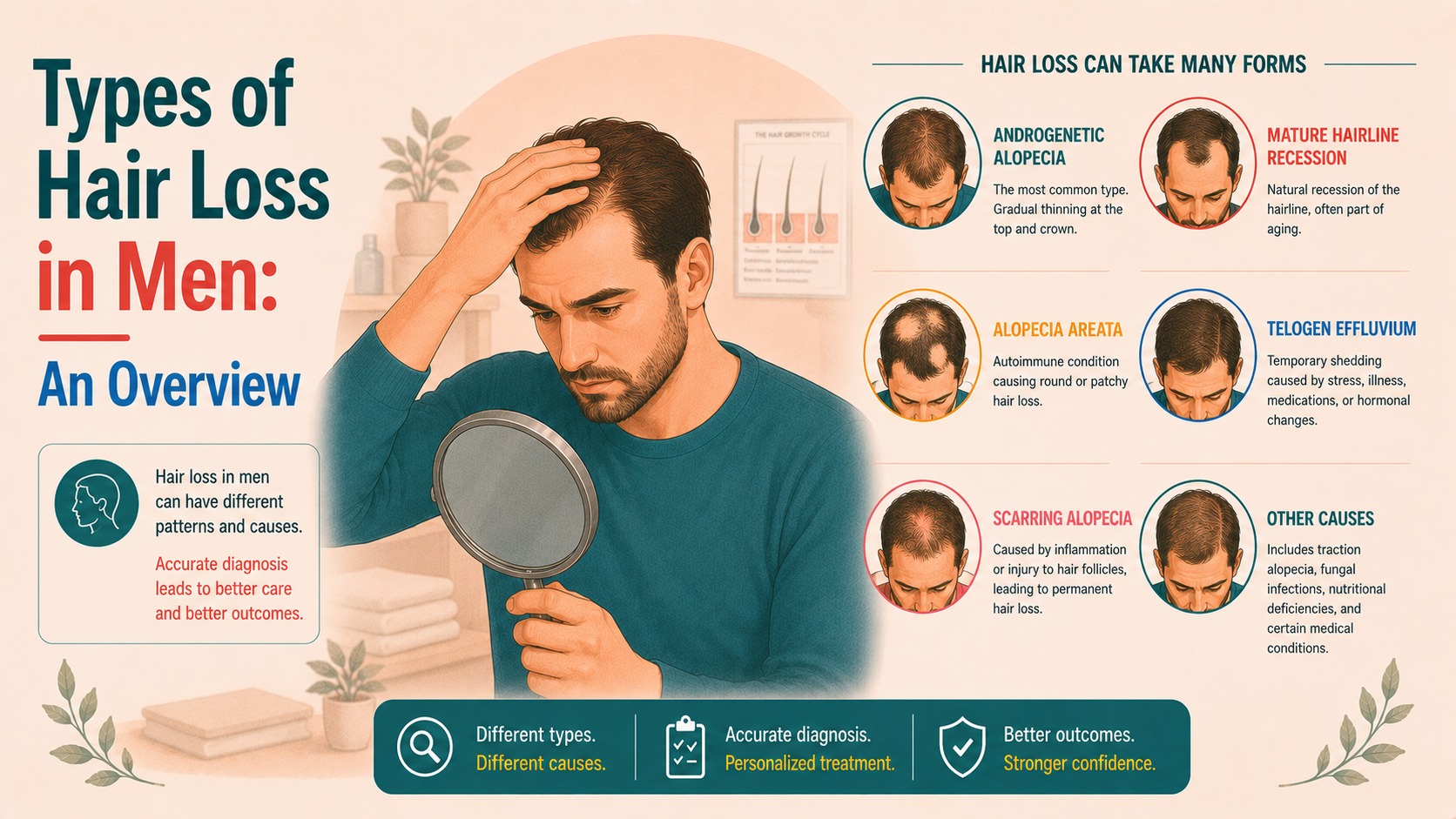
When a man loses hair, almost everyone calls it “male pattern baldness” by default. In fairness, androgenetic alopecia is extremely common and does explain the majority of thinning in men. But it does not explain all of it.
Men can be affected by:
Some of these are benign and reversible. Others are scarring and need early recognition to prevent permanent loss. This overview gives the lay of the land so that later, more specific articles sit in a clear context.
Most classification schemes start by asking a single question:
“Are the hair follicles still structurally present, or have they been destroyed and replaced by scar tissue?”
Both types occur in men. Within each category, patterns and causes diverge.
This is by far the most common form of hair loss in men.
Key features:
Biology in brief:
This pattern is characterised using the Hamilton–Norwood classification, ranging from early recession (Types II–III) to extensive baldness (Type VII).
Telogen effluvium is a state where more follicles than usual enter the telogen (resting) phase in a synchronised way, thus leading to a synchronised exogen, causing sudden, increased shedding a few months later.
Typical triggers in men include:
Features:
In classic telogen effluvium, follicles are not destroyed. Once the trigger resolves and systemic health is restored, the cycle usually normalises over several months. In many men, telogen effluvium and androgenetic alopecia coexist; the former unmasking or worsening the visible pattern.
Alopecia areata is an autoimmune condition in which immune T-cells target the lower hair follicle in anagen, causing rapid shedding.
In men, it can present as:
The scalp skin in affected areas looks smooth and normal; there is no scarring. Exclamation mark hairs and black dots may be seen on close inspection. The course is unpredictable: some men experience one or two patches that regrow spontaneously, while others have chronic or relapsing disease.
Traction alopecia results from chronic tension on the hair, most often from:
In men, it is less common than in women, but does occur, particularly along the hairline. Early on, it is non-scarring and reversible with the removal of the traction. Sustained traction over years, however, can lead to scarring at the most stressed margins.
Trichotillomania involves recurrent hair pulling, often associated with rising internal tension and a sense of relief during pulling. In men, it may affect the scalp, beard, eyebrows or body hair.
Clinically, the hallmark is an area with hairs of variable length, broken shafts, and sometimes co-existing normal hairs. The pattern may be irregular and does not conform to the classic pattern of androgenetic alopecia. Over time, chronic mechanical trauma can damage follicles and create permanent thinning in the most affected areas.
Though more common in children, tinea capitis can occur in adult men, particularly those with close contact with children or in certain occupational settings.
Features:
This is a fungal infection, not an immune or hormonal problem. It requires systemic antifungal treatment. Delay can increase the risk of permanent scarring in severely inflamed cases.
Some men experience telogen effluvium – abrupt, diffuse hair loss – with chemotherapy agents that forcibly arrest matrix cell division. The pattern depends on the regimen.
Other medications associated with non-scarring hair loss (usually telogen effluvium) include:
Temporary shedding can also occur after starting new hair-loss treatments, such as minoxidil or finasteride; it is common and usually resolves, indicating the treatment is working. It's advised to continue treatment in this instance.
In many cases of drug-induced hair loss, hair regrows once treatment is completed, though the timeline and extent vary.
Scarring alopecias are less common than non-scarring conditions but more serious, as follicles are permanently destroyed. They should be on the radar for any male patient with:
Lichen planopilaris (LPP) is a lymphocytic scarring alopecia targeting the upper follicle. In men, it may cause:
Frontal fibrosing alopecia (FFA) is considered a clinical variant of LPP. It is more common in women but does occur in men, often presenting as:
Early recognition and immunomodulatory treatment can halt progression, but do not regrow scarred areas.
CCCA classically affects women of African descent, with scarring alopecia radiating from the crown. It is much less common in men, but can appear with similar crown-centred patterns. Differentiation from advanced androgenetic alopecia may require dermoscopy and biopsy in equivocal cases.
Folliculitis decalvans is a neutrophilic scarring alopecia, usually in men, characterised by:
It reflects a chronic, destructive follicular inflammation often associated with bacterial colonisation. Long-term antibiotic and anti-inflammatory regimens are typically required.
Dissecting cellulitis primarily affects young adult men, particularly of African descent. Features include:
It is part of the “follicular occlusion tetrad” along with acne conglobata, hidradenitis suppurativa and pilonidal disease. Early dermatological management can reduce long-term damage.
Discoid lupus erythematosus (DLE) can involve the scalp in men, causing:
Other vasculitides and connective tissue diseases can occasionally create scarring scalp lesions. These are rare but important to recognise early.
Physical injury to the scalp, thermal burns, and high-dose radiotherapy can all destroy follicles and leave sharply demarcated areas of permanent loss. In these settings, the cause is usually evident from history and the pattern of scarring.
These are much rarer, but for completeness:
These conditions are typically recognised in childhood or adolescence rather than presenting as new adult hair loss.
From a practical standpoint:
The key message is that not all hair loss in men is simply the same condition manifesting at different speeds. Good care begins with pattern recognition and, when needed, dermoscopy and biopsy to confirm which of these processes are present.