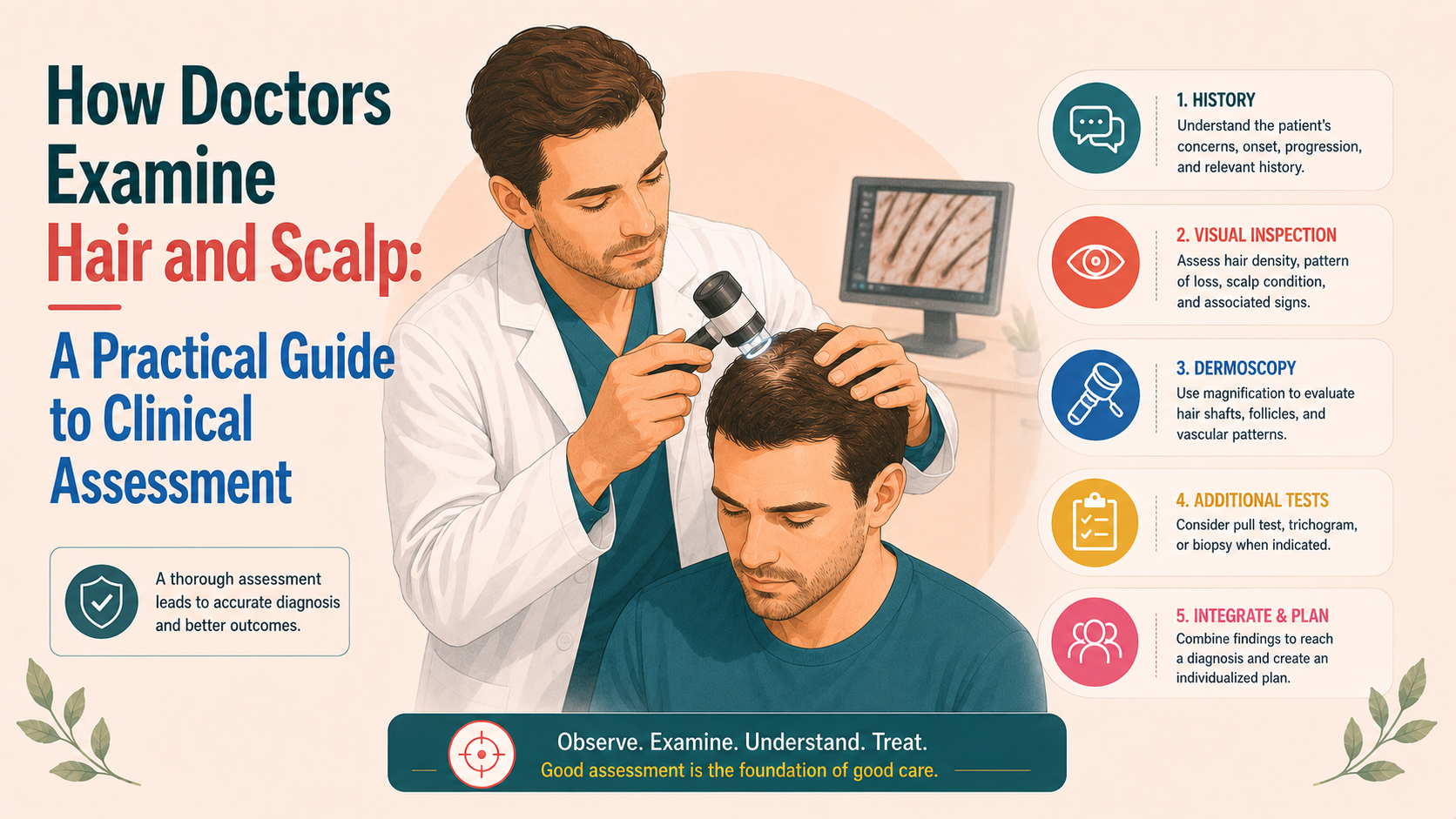
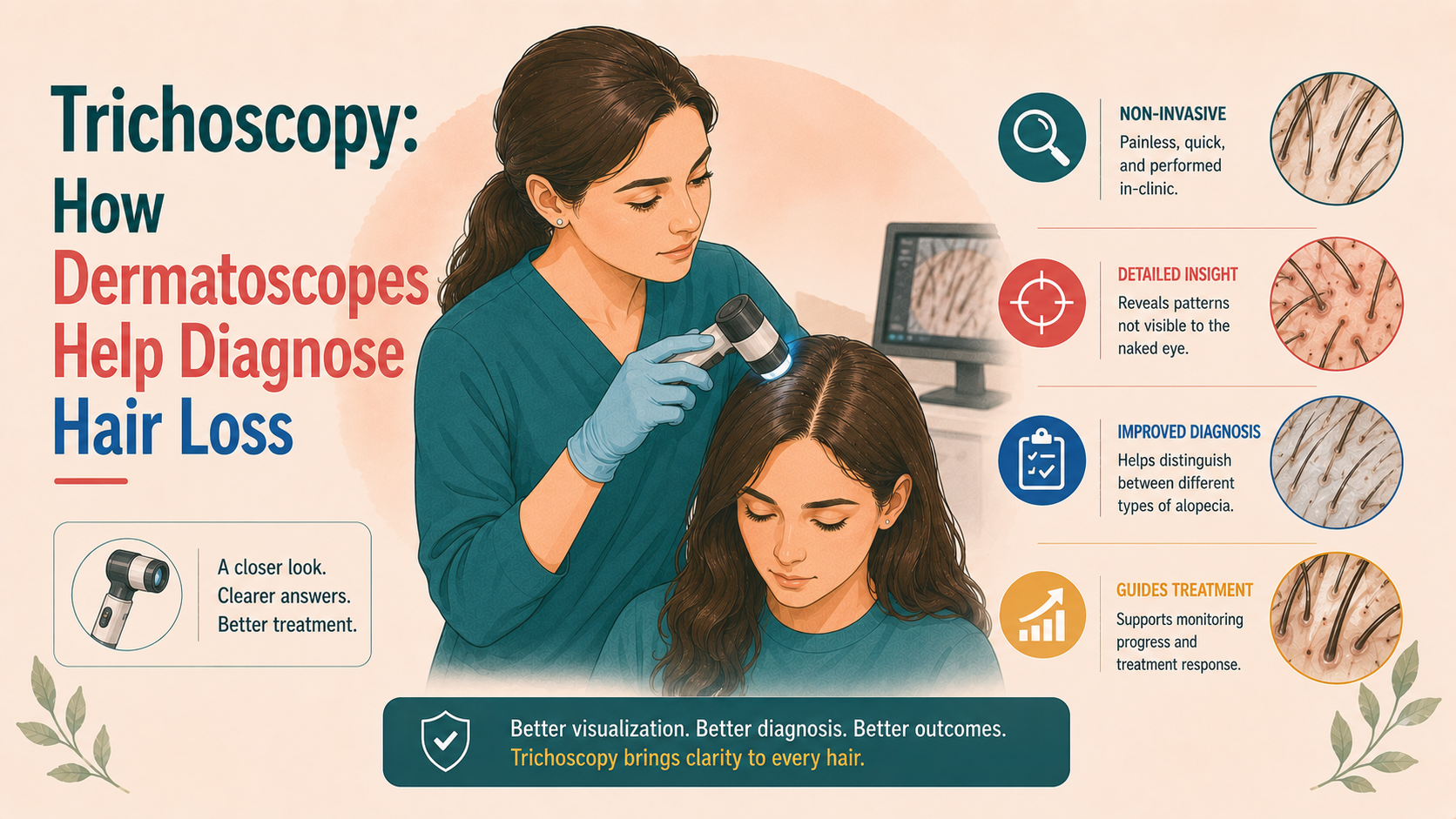
Magnified examination of the scalp and hair using a dermatoscope or digital device.
Trichoscopy is one of the most useful diagnostic tools in hair loss. It is non-invasive and helps identify patterns that are difficult to see with the naked eye. In androgenetic alopecia it can show hair shaft diameter diversity, increased single-hair follicular units, thin hairs and peripilar signs. In alopecia areata it may show yellow dots, black dots and exclamation mark hairs. In scarring alopecia it can show loss of follicular openings and inflammatory signs. Trichoscopy does not replace clinical judgement, but it improves diagnostic accuracy and follow-up.
DermNet: Trichoscopy of generalised noncicatricial hair loss — https://dermnetnz.org/topics/trichoscopy-of-generalised-noncicatricial-hair-loss; Anastassakis K. Androgenetic Alopecia From A to Z, Vol. 1, Springer, 2022 — https://doi.org/10.1007/978-3-030-76111-0; Starace M et al. Female Androgenetic Alopecia: Diagnosis and Management, Am J Clin Dermatol, 2020 — https://doi.org/10.1007/s40257-019-00479-x