Join the Newsletter
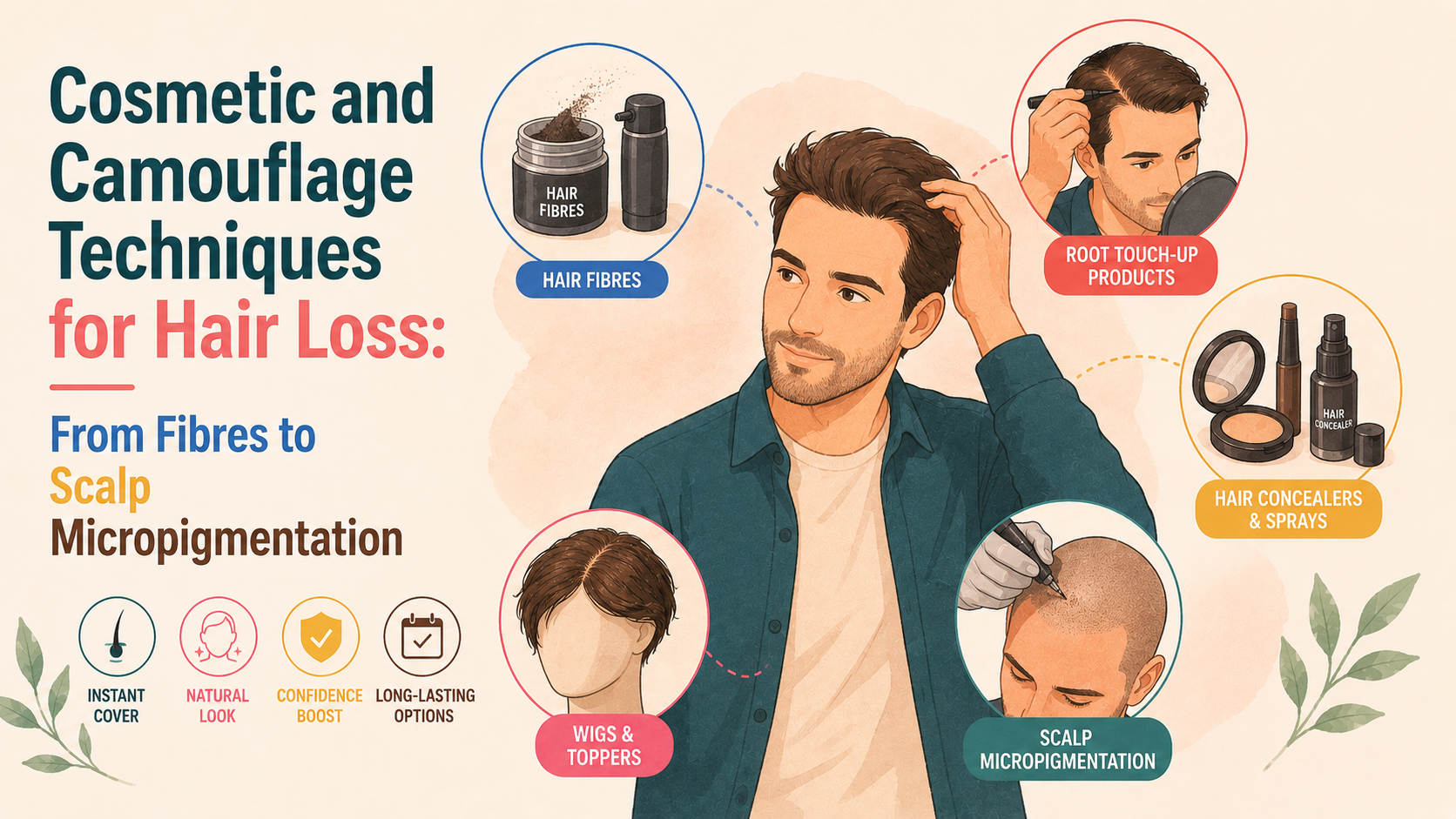
Not everyone wants, needs or can tolerate medical or surgical treatment for hair loss. Cosmetic and camouflage techniques – from styling and concealers to wigs, hair systems and scalp micropigmentation – can make thinning far less visible and often improve confidence and quality of life. This article explains the main options, the science and psychology behind them, what evidence we have, and how to use them safely and thoughtfully.
![[headshot]](https://cdn.prod.website-files.com/68207da82e5b8c350c67932f/68c6a7436a552c0fe87a4da7_Screenshot%202024-11-27%20at%2011.38.11.png)
Hair loss has a psychological footprint that goes well beyond the scalp.
Research in both men and women shows that androgenetic alopecia and alopecia areata can reduce satisfaction with appearance and body image, increase self-consciousness in social and professional settings, and trigger coping behaviours, from avoiding bright lights and cameras to repeatedly checking mirrors.
Patients often worry that others will notice their hair loss, feel older, less attractive, or less professional, and avoid activities such as swimming, exercising, or going out in windy conditions for fear that their hair loss or cosmetic aids will be exposed.
Parallel research on wigs and hair prostheses in alopecia areata and other severe hair loss conditions consistently finds that well-fitted wigs and hairpieces improve perceived quality of life, self-esteem, and social functioning. Satisfaction with a wig’s appearance and comfort is closely linked to psychological benefit, while cost, visibility, and fear of the wig being noticed or dislodged can limit its use for some patients.
Viewed in this context, camouflage is not trivial. It is a legitimate component of treatment, particularly while medical therapies are taking effect, when medical or surgical options are limited or declined, and when regrowth is likely to be partial or unpredictable.
It is also one of the few interventions that can change how you look today rather than in six months.
Before any product or procedure, small changes in styling can make thinning less conspicuous.
Common approaches include:
These are simple, low-risk steps. For some, they are enough. For many, they are combined with topical concealers.
Topical concealers aim to reduce scalp show-through and create the impression of greater hair density. They are most effective when there is still a reasonable amount of hair present, thinning is mild to moderate, and the goal is to reduce contrast between the hair and scalp rather than mask completely bald areas.
Hair fibres are very fine synthetic or keratin-based fibres applied as a powder or spray over thinning areas. They are electrostatically charged, so they cling to existing hairs.
They help by adding apparent bulk by thickening individual shafts, reducing scalp contrast, especially in diffuse thinning, and can be colour-matched to existing hair.
Advantages:
Disadvantages:
For many patients with androgenetic alopecia, fibres are a simple, powerful daily tool.
Colored sprays, root touch-up products, and pigmented powders tint the scalp skin to reduce visible contrast through the hair. They can be applied along part lines, at the hairline, and in small patchy areas, and are useful for both men and women.
They are often used in combination with fibres and styling for best effect.
Some patients use specific scalp make-up products or general cosmetic products (e.g. mineral powder, foundation) to tint the scalp.
These are more labour-intensive and best suited for small visible areas, such as thinning parts or along the frontal hairline.
Hair prostheses sit on a spectrum from temporary fashion accessory to medical device and long-term coping strategy.
They generally come in two types: synthetic fibre and human hair. Synthetic fibres are typically lighter, more affordable, and low-maintenance, but they are less durable and not ideal for heat styling. Human hair is more natural-looking and offers greater styling versatility, but it is more expensive and requires more maintenance.
Multiple studies across alopecia areata, androgenetic alopecia and other hair loss conditions show that:
At the same time, qualitative research highlights that wigs can cause anxiety about being “found out,” create worries about movement, wind, intimacy and physical activity, and evoke feelings of inauthenticity or a sense of “hiding.”
These mixed feelings are normal. They are not a reason to avoid wigs, but a reminder that emotional support and realistic discussion of the pros and cons matter.
Key questions when choosing a wig or hairpiece:
Important safety notes:
A knowledgeable wig fitter / cranial prosthesis specialist, ideally familiar with medical hair loss, is invaluable.
Scalp micropigmentation is essentially medical tattooing designed to simulate hair.
Scalp micropigmentation (SMP) uses small, dot-like deposits of pigment in the upper dermis, designed to mimic shaved hair stubble or a natural scalp shadow. These deposits are placed in patterns that mirror normal follicular distribution.
SMP is used for men with advanced androgenetic alopecia who prefer a shaved look, creating the illusion of a full, closely shaved scalp of hair. It is also used in both men and women to reduce the contrast between hair and scalp in cases of diffuse thinning or scarring alopecia, particularly in the crown or along the parting. In addition, SMP is employed to camouflage donor scars from FUT/FUE hair transplant procedures and other types of scalp scars.
Recent case series and prospective studies have reported:
Newer studies are beginning to standardise needle choice and depth, pigment density and colour selection, and techniques for avoiding unnatural uniformity or “helmet” effects.
Overall, SMP appears to be a safe and effective aesthetic adjunct when performed by trained practitioners using appropriate equipment and medical-grade pigments. It also does not preclude future hair transplantation at the site of deployment.
Potential issues include:
Correction clinics are seeing more patients with unsatisfactory SMP, particularly those treated at low-cost centres using aggressive techniques. As with transplant surgery, choosing the operator and clinic matters as much as the procedure itself.
Extensions and weaves occupy a complex space, particularly for women and people with Afro-textured hair, where hair and scalp are tightly linked to cultural identity, styling practices are both artistry and expression, and hair camouflage intersects with a long history of racialised hair norms.
Extensions, braids, weaves, and added hair can cover thinning areas, particularly in the crown or mid-scalp, build volume and length, and allow for protective styling that reduces manipulation of fragile hair shafts.
When applied thoughtfully, they can be a powerful tool for both expression and camouflage.
However, chronic use of high-tension hairstyles is a well-documented cause of traction alopecia, particularly along the frontal and temporal hairline. The risk is highest when styles are tight, heavy, and left in place for extended periods. If unaddressed, traction alopecia can progress from non-scarring to scarring hair loss.
Best practices include:
Critical reviews of camouflage in Black women with alopecia emphasise that hair prostheses and extensions are often first-line coping strategies, and that education on tension, attachment, and scalp health is essential to avoid worsening the underlying condition.
For many people, especially women, eyebrow and eyelash loss can be as distressing as scalp involvement.
Options include:
Microblading and micropigmentation for eyebrows can provide dramatic, long-lasting improvement for patients with alopecia areata, frontal fibrosing alopecia (FFA), and other conditions that affect the brows. However, they share similar risks with scalp micropigmentation (SMP), including colour changes, line blurring, infection, and dissatisfaction, especially when performed by inadequately trained practitioners.
In people with active autoimmune disease, pigment uptake and retention can be unpredictable; realistic expectations are important.
Hair loss and camouflage live at the intersection of medicine and culture:
Qualitative studies with men and women using wigs, systems and camouflage point to:
These are not pathological; they are understandable responses to living in a culture that equates thick hair with youth, health and desirability, stigmatises visible hair loss, particularly in women, and simultaneously mocks and demands cosmetic efforts.
From both clinical and coaching perspectives, the role is not to judge whether someone should use camouflage, but to validate that these tools are legitimate, help them use them safely and, where needed, help them loosen the belief that hair, or its absence, is the only thing that defines their worth.
Camouflage sits alongside, not instead of, other treatments:
Clinicians who treat alopecia well are increasingly asking about current camouflage use, offering practical advice or referrals to wig/SMP specialists, and acknowledging that for many people, the psychological relief from camouflage is as important as millimetre-level improvements in density.
Questions to ask yourself:
Most importantly: there is no single “correct” choice. What matters is that the approach aligns with your diagnosis, preferences, budget and emotional needs, and helps enable you to live more peacefully.