Join the Newsletter
Regenerative medicine aims to help the body repair and rebuild itself. In hair loss, that means trying to wake up sluggish follicles, protect their stem cells, and enhance their environment rather than simply slowing damage. This article explains the main regenerative approaches being used or studied in alopecia, including what we know, what remains experimental, and how to think about them sensibly.
![[headshot]](https://cdn.prod.website-files.com/68207da82e5b8c350c67932f/68c6a7436a552c0fe87a4da7_Screenshot%202024-11-27%20at%2011.38.11.png)
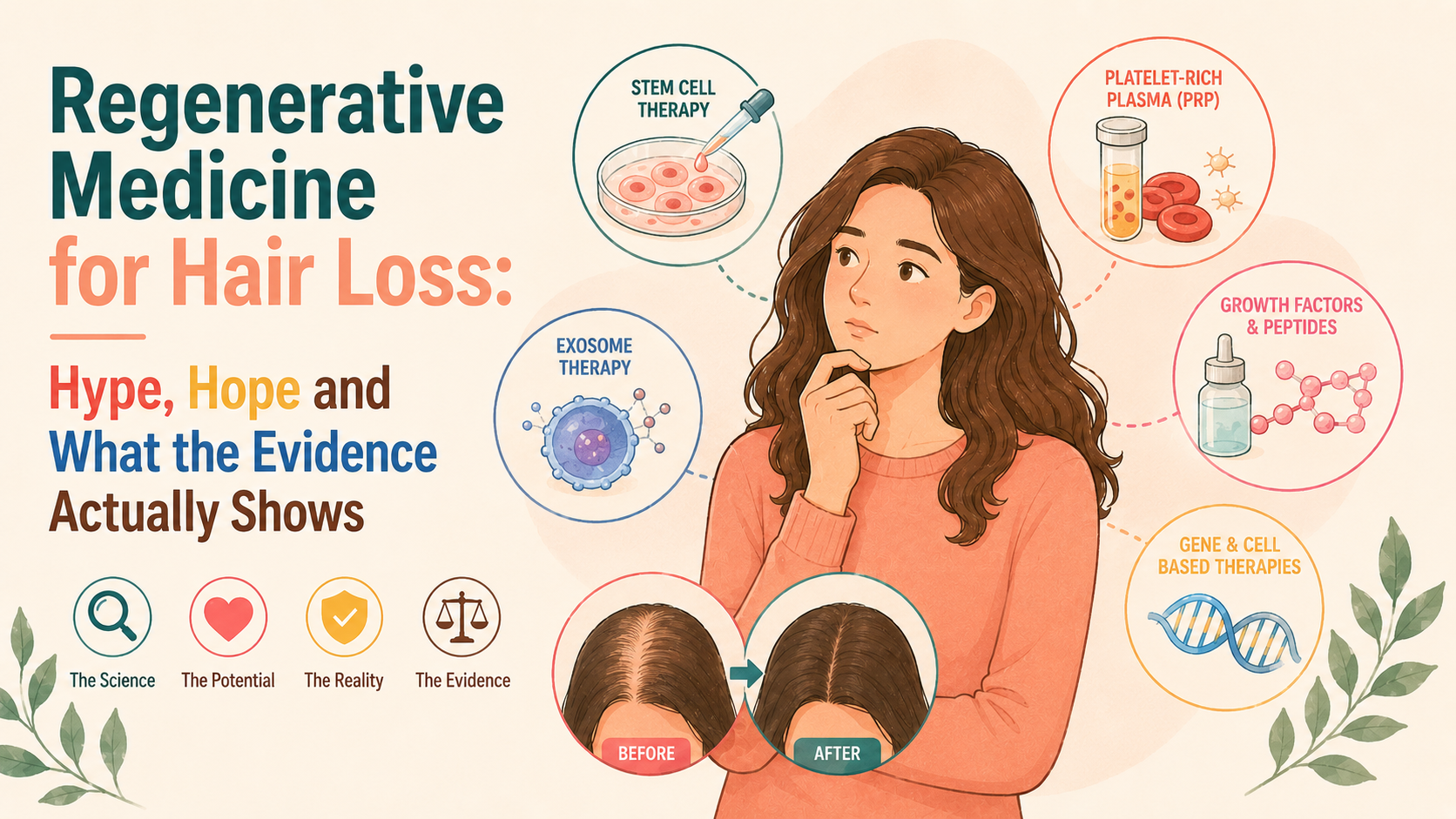
Regenerative medicine is not one single treatment. It is a broad label for techniques that aim to:
In the context of alopecia today, “regenerative” usually refers to:
These techniques do not change the underlying genetics or hormonal milieu, and they don’t replace minoxidil or 5-alpha reductase inhibitors. They sit as adjuncts or potential alternatives in people who cannot tolerate conventional drugs, or who seek extra benefit on top.
The challenge is that this field moves quickly, evidence quality is mixed, and commercial enthusiasm easily outruns science. The aim here is to orient you without overselling.
Hair follicles are, by design, regenerative mini-organs: they naturally cycle between growth (anagen), regression (catagen), rest (telogen), and shedding (exogen). They contain stem cell populations in the bulge and dermal papilla that can restart growth each cycle. They also respond to a range of biochemical signals (Wnt/β-catenin, Shh, BMP, Notch, prostaglandins) that govern when they grow, rest, or shrink.
In androgenetic alopecia and other hair disorders, these stem cell populations and signalling networks are present but dysregulated: the stem cells remain, but their ability to produce robust new hairs is impaired; the microenvironment is less supportive (micro-inflammation, poorer vascularisation, oxidative stress); and the balance of stimulatory and inhibitory signals is skewed.
Regenerative techniques attempt to nudge the system back toward a healthier state by either delivering growth factors and cytokines, delivering cells or cellular derivatives with regenerative potential, or stimulating endogenous stem cells with physical or light-based cues.
Platelet-rich plasma (PRP) is an autologous treatment derived from your own blood. The portion of the blood that does not comprise red blood cells is spun in a centrifuge to concentrate platelets and, in some cases, leucocytes (white blood cells). This concentrated mixture is then re-injected into the scalp.
Platelets release a variety of growth factors, such as VEGF, PDGF, TGF-β, IGF-1, EGF and others, which can theoretically promote angiogenesis (blood vessel formation), cell proliferation and matrix remodelling around the follicle. In other words, stimulate growth through methods similar to natural healing pathways.
In alopecia, PRP is thought to extend the anagen phase, stimulate dermal papilla cells and bulge stem cells, improve local blood supply, and reduce microinflammation.
In the last decade, dozens of clinical trials have evaluated PRP in male and female androgenetic alopecia:
However:
Studies in women with female pattern hair loss show significant increases in hair density and shaft diameter compared with baseline or placebo in many trials, good tolerability, and particular usefulness as an adjunct to minoxidil and/or systemic therapy.
Again, results vary, but PRP is often purported as a reasonable adjunctive option in appropriately selected women willing to invest the time and cost.
Variations on PRP include:
Early laboratory and small clinical studies suggest these may enhance hair-related pathways and regrowth. They remain refinements within the broader PRP ecosystem and, for now, should be considered experimental adjuncts rather than distinct, proven therapies.
“Micrografts” in this context refer to tiny, mechanically disaggregated fragments of a patient’s own tissue (often scalp) which are processed to yield a suspension rich in progenitor/stem cells, extracellular matrix and growth factors. This suspension is then injected into the target scalp areas.
Devices such as Rigenera and others standardise this mechanical processing.
Clinical studies have harvested small scalp punch biopsies (e.g., 2.5 mm), processed them into micrograft suspensions containing follicular stem cells and dermal papilla cells, and then injected the suspensions into thinning areas.
Reported outcomes in androgenetic alopecia:
Newer work in women with AGA suggests similar short-term benefits after even a single session of autologous micrografts, though sample sizes are small and follow-up is limited.
Adipose tissue (fat) is an accessible, rich source of mesenchymal stem cells. Approaches fall into several categories:
Randomised controlled trials have shown that:
Some studies have isolated hair follicle mesenchymal stem cells from occipital donor areas, expanded them in culture, and then injected them into balding regions.
Trials report increases in hair density and calibre in advanced AGA, including in individuals with limited responses to standard therapies. Threshold hair shaft diameters have been proposed as predictors of response.
These methods are more complex, often requiring cell culture facilities, and are closer to translational research than to routine clinical practice.
Systematic reviews of stem cell-derived treatments in AGA conclude that stem cell-based and cell-derived therapies (follicle-based, adipose-derived, bone marrow MSCs, etc.) show promising efficacy signals in RCTs and case series, including improvements in density, thickness, and sometimes in patient satisfaction. Safety in the short term appears acceptable, with mostly mild local reactions.
However, sample sizes are modest, protocols heterogeneous (not standardised), and follow-up often short; results must be interpreted with caution until replicated in larger, longer studies.
At present, these therapies are best framed as experimental or adjunctive treatments in specialist centres rather than mainstream first-line options.
“Conditioned media” refers to culture media in which stem cells (e.g. adipose-derived, follicular, bone marrow MSCs) have been grown. This fluid is enriched with growth factors, cytokines, and extracellular vesicles secreted by the cells; the cells are then removed, and the medium is applied topically or injected.
Multiple RCTs and a recent meta-analysis show that stem cell-derived conditioned media:
The mechanism is purely paracrine; in other words, we are delivering signals, not cells.
Exosomes are nano-sized, membrane-bound vesicles released by cells carrying proteins, lipids, mRNA and microRNA, and are involved in cell-to-cell communication.
In hair regeneration, exosomes may stimulate follicular stem cells, modulate immune responses and micro-inflammation, and enhance angiogenesis and antioxidant defences.
Clinical work to date includes:
Laboratory work with platelet-derived exosomes suggests they may mimic some PRP effects while allowing a more controlled, cell-free product.
Exosome therapies are among the most active areas of hair regeneration research; however:
They should be regarded as promising but early.
LLLT, using red or near-infrared wavelengths, is often grouped with regenerative treatments because it appears to:
Clinical studies in men and women with androgenetic alopecia show increased hair counts and thickness with regular use (typically several times per week) over several months, and demonstrate good safety, as the treatment is non-invasive and does not involve systemic drug exposure.
Mechanistically, LLLT likely represents a biostimulatory intervention: nudging follicles into a more regenerative state by physical energy rather than biochemical agents.
It is not as potent as strong pharmacological or cell-based interventions, but it can be used safely long-term. It may be particularly appealing to those who prefer non-drug options or wish to layer it onto existing therapy.
As with all such devices, real-world effectiveness depends heavily on adherence.
For most patients with androgenetic alopecia and other common non-scarring alopecias:
In scarring alopecias, the priority is controlling inflammation with immunomodulatory drugs and carefully selected topical therapy; regenerative techniques can only support surviving follicles, they cannot replace those destroyed by scar.
For alopecia areata, Janus kinase (JAK) inhibitors and other immune-targeted agents are the emerging mainstay; regenerative techniques may have supportive roles but are not a substitute for modulating the autoimmune process.
Regenerative interventions should, at this stage, be seen as complements rather than replacements: they make most sense in combination with, and in addition to, standard care.
A few pragmatic points:
Warning signs in the market include:
A good clinician will explain what is known and unknown, present regenerative options as one component of a broader plan, and discuss cost, likelihood of benefit, and the need for repeat sessions or maintenance.
Areas to watch include:
The likely near-term reality is not a single, game-changing cure, but a progressive enrichment of what we can offer: better adjuncts, more durable enhancements, and a more nuanced use of the follicle’s inherent regenerative capacity.
Regeneration in hair medicine is real, but it is incremental and not magical. It will be most beneficial to harness it without being swept away by the hype. However, it is also certainly worth monitoring closely.